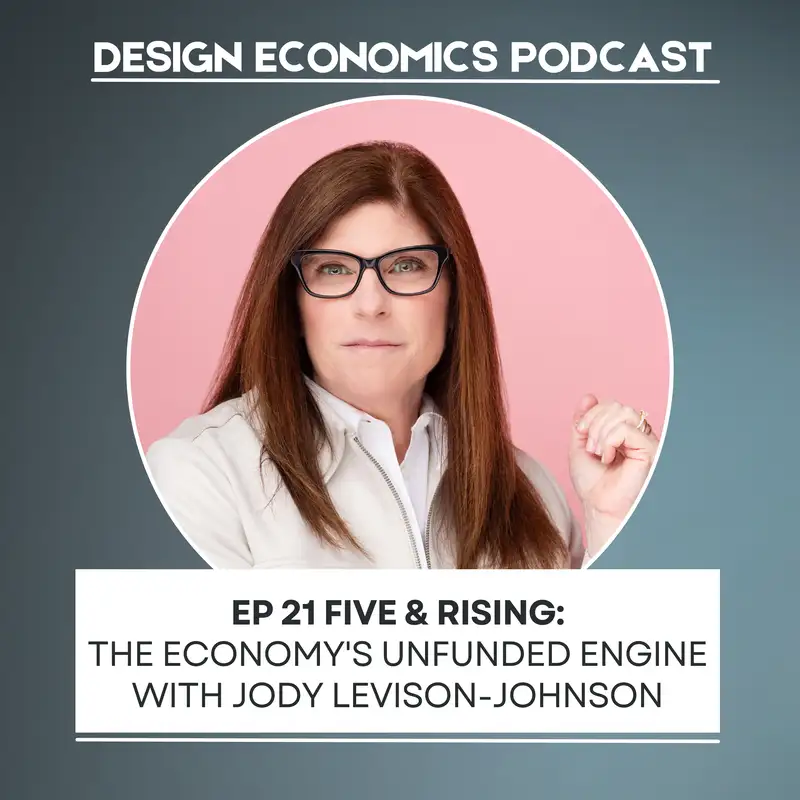
Jody Levison-Johnson: Five & Rising; The Economy's Unfunded Engine
When we dug into the work from United Way, one of the findings within that Alice body of work is that 22% of people who work in this sector qualify as Alice, which is asset limited, income constrained, employed, or at the poverty level. So a fifth of the workforce, and then I look at what the workforce status, it's like, we employ 12,500,000 people. So a fifth of that are living in this asset limited or at the poverty level. And we expect yet these people to either contribute to the betterment of the environment, the betterment of societal functioning, the arts and culture aspect, as well as taking care of people. And yet they too are struggling to put food on their own tables.
How do we really equip a workforce to be effective when they can't even make ends meet?
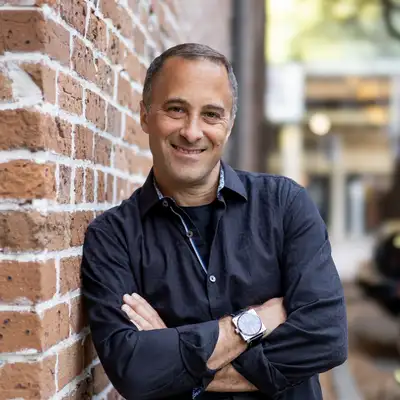
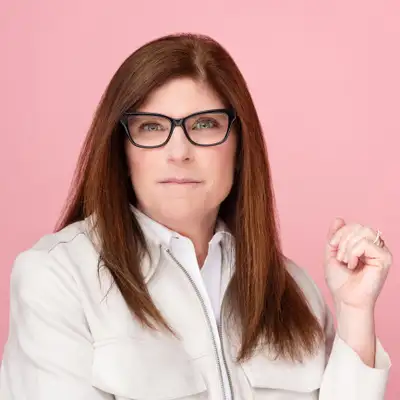
Vinny Tafuro: Hello, and welcome to episode 21 of the Design Economics Podcast, where we explore how design thinking driven by data is revolutionizing economics for the twenty first century. My name is Vinny Tafuro, a futurist, economist, and your host for this episode. My guest today is Jody LevisonJohnson, president and CEO of Social Current, a network of nearly 18 hundreds service organizations and the founder of Five and Rising, a movement to revalue, reframe, and rebuild how the social sector is funded and supported. Our conversation explores why our economy's most essential sectors are systematically underfunded and what it would take to change that. Before we begin, if you find value in these conversations, please consider supporting the Design Economics Podcast through our Patreon.
Your support helps us to continue bringing these important conversations to a wider audience. Visit patreon.com/evolveeconomics or our episode show notes @designeconomics.io to learn more. And with that, I hope you enjoy this conversation with Jody Levison-Johnson.
Thanks for having me, Vinny. Excited to talk about all this with you.
Vinny Tafuro: Right. You know, I had, I kind of came across Jody, you in two phases. One, it was through an article that was out in the Uncharitable's newsletter, about the social sector, but then it was really in, I think February or so, there was a Forbes article about the, engine of, you know, why we must treat the social sector like the engine of the economy or an economic engine. And I remember even, like, the intro paragraph about, you know, we think of manufacturing. I know I'm I'm, based in Tampa, Florida, and we're we're talking about sports as an economic engine as we evaluate a new sports stadium, which happens all around the country and and whatnot.
So it was really good to I really enjoyed reading that and hearing that terminology and then reading about Social Current and reaching out to you. I'm really glad you're here. I would love to have, you've kind of first maybe introduce yourself, how you got to where you are and, a little bit about Social Current and kind of the landscape or ecosystem of the space you're working in.
Sure. So, I am the president and CEO of Social Current and, licensed social worker by training. And I've spent the entirety of my career, which is longer than I care to actually admit, but working in human services. And when I say human services from all different angles. So in my career, I've worked on behalf of local government, county government.
I've also worked in state government in behavioral health. I've worked in national associations. I've done direct clinical time as a direct care staff person, as a social worker, and then as an administrator and a leader. And I think sort of the thread through all of that is really just a personal conviction that from a very young age, after suffering the loss of a close friend to suicide, really realizing that systems don't work for the people who need them when they need them. And so that's sort of been sort of my personal call to action.
And so in 2019, I landed at the Council on Accreditation as the chief executive officer. And part of that work as an accrediting body for human service organizations was really to make sure that what we were doing had value and impact to the customers, but I think also to ultimately the consumers of those services. And so that led to my leading the Council on Accreditation through a merger with a membership association, the Alliance for Strong Families and Communities, and forming Social Current. And so social current really, when I think about social current, I think that we exist to strengthen the social sector. And I say social sector as opposed to nonprofit organizations, because I personally think that there isn't a very good sort of message in defining yourself and talking about who you are by saying what you aren't.
So really when I talk about the social sector, I'm talking about nonprofit primarily, but also human service organizations who deliver services to humans in various times of need and for various reasons. And the social sector is broader than that. It certainly includes arts and cultural and environmental organizations, all types of organizations. Social Current Slice is really focused on human services and five and Rising is really about the whole sector. It's about how the entire kind of universe of nonprofits is created and really thinking about creating a national movement that allows us to rethink how the sector is funded, how it's valued and how it's supported.
And that really, I think, is a big part of what you saw in the Forbes article. So Social Current does a lot more than just Five and Rising. We continue to accredit organizations. We provide training, technical assistance and consultation in a variety of different areas. And then part of what we are also doing is really trying to leverage our platform as a national organization to raise awareness and create this movement about how our sector is marginalized.
And so that's really kind of like in a nutshell what it's about, but happy to dig into any part of that that might be of bigger interest.
Vinny Tafuro: Absolutely. And I'm looking forward to pulling on a few of those things. And I mean, that is, know, like I said when I first came upon your work and the organization, was that shared premise that we have about how we talk about this sector. I have a colleague and long time mentor of over twenty twenty five years now, long time, that that was the first one that probably really had used the social sector language with me. And I mean, she was the CEO of like statewide organizations.
It really, remember I when I started looking at this in twenty seventeen, sixteen, eight, like in that sec you know, talking about social capital, people are like, what are you talking about? And now, you know, here we are, you know, nearly a decade later and people are starting to use the language. Although I would, you know, I think we'd probably have both run across where where they're not using it quite right. It's still, oh, social networking, social capital, and it's way deeper ingrained in society that way. I guess where we can start with this is really kind of this acknowledgment of paradigm chain.
I just I kinda just identified you and you I in seeing you you nod in agreement to that, the the the last ten years we've gone from social capital not being a word to how do we advocate for social capital and social infrastructure in the social sector replacing this charitable, idea or nonprofit idea. I love I love your statement that, you know, I don't wanna identify by what I'm not. And, I think that that's a wonderful way to start. I guess, what was the kind of in your roles leading up to Five and Rising, what was the kind of what are the things that led to, like, we need five and rising. This is the initiative we want to get behind.
Absolutely. I think, you know, it's so interesting because when I first talked about this, it was before we even named it five and rising. It was at one of our social currents national conferences. And I talked about how we perpetuate the narrative that we are now sort of straddled with or hampered by. And as a person who ran an organization that provided services in five different places across The US, services to young people and their families who were in need and struggling, I would do what it took to get the contracts.
And so I remember saying it on that stage that day was, I'm complicit in perpetuating this narrative, which is that we aren't an economic engine that deserves to get paid what we cost or what we're worth. And so I remember writing proposals to state governments when I was in that role. They'd come back to us after writing a proposal and say, What's your best and final offer? And what I should have said was our best and final offer is what we put in the proposal because that's what it's going to take us to do this work and to do it well and to achieve the outcomes and the impact that we have proven we've been able to achieve in other places. And instead I ended up going, Oh, we can put a little less Jody time.
We can throw a little less wraparound flexible funding. We'd skewed back. And I think that's mindset that we as a sector have learned to embrace because it is how we are. And I was talking with CEOs from across the social current network. I make a point of talking to our networks leaders regularly to make sure I'm keeping my eyes and ears on the ground.
And I was hearing all about this skewing back, not being able to make ends meet, programs being cut, staff being reduced or eliminated, raises not being given. We're always doing things on the cheap. They were surfacing that this was the biggest impediment to really achieving the impact that they hoped they could in their communities. And I just kept thinking like, I did it. I'm hearing all these other folks do it.
Why aren't we doing something about this? And so I went to our leadership team and then to our board of directors and said, we got to do something about this. And either coincidentally or serendipitously, I don't even know if that's a word, but It sounds like it should be, but uncharitable, which was this great TED Talk by Dan Pilotta from many, many years ago, a great book from many, many years ago was being made into a film. And so at right the same time that I started getting pretty hot about this issue. And what I was realizing though, is that the book, the TED Talk had been around for a decade, kind of what you were reflecting on, like we've been talking about this for a long time, hadn't really changed much.
And so really thought that now is the time, we have this infrastructure at Social Current, we're this national network, we span across The US and Canada. We have attention that we can maybe get for this issue. Let's think about it. And so started talking with the film team about how can we help you make the film stick? And realizing that the film and the book and the TED Talk all incredibly powerful, but don't cover everything because there's a heavy emphasis on philanthropy, which is a big part of this.
And what we're finding in our network is there's a big part of this where it's about government contracts not covering full costs. It's about philanthropy having to fill the holes left by other contracts. It's about having to have a gala or a golf tournament to keep your lights on and your doors open. The ludicrousness of that paradigm and of that model is just like in no other place. Like if I was Ford manufacturing a car and it costs me 5,000 to do that, and then the market said, Well, we're only gonna pay you 4,000 for that car.
Well, guess what? I wouldn't continue to manufacture it. I would discontinue the model. But we keep doing it. We keep doing things on the cheap and we do them and we're just continuing to expect to be able to do them on the cheap.
And so I think that's what really sort of led to us feeling like it was time to stand up and say, we've got to shift this narrative. And when we started digging in and realizing that the sector is five point I think it's now 5.3 of the GDP, that it's like trillions of dollars in the economy, that it's 12,500,000 people who are employed in this sector. We are a force to be reckoned with, but people don't realize that. And I realize that people don't realize that because like I said, I've been working in the sector since I came out of college and I didn't realize that we were such a big driver and economic engine. So I started thinking about not only are we an employer, but we are purchasers of goods and services.
We buy health insurance, like all the things. So we've got to really think about what does it mean? It's not just about who we serve and what we do in communities, but it's also who we are in communities that we live and work in and what we contribute. So that's, I think, really where it all kind of came together is this, we have to do something.
Vinny Tafuro: Yeah. Yeah. I see that. It's interesting because I had also stumbled on Dan's TED Talk shortly after it came out when it was gaining notoriety. And, you know, at that point, he was talking to the philanthropic community.
Like, the the words the rest of the language and infrastructure wasn't there yet. I I I think back, like, you know, when when we started the like, as you iterate, you kinda become sharper and sharper and more people help kind of put that that language together. And I think a big part of it is that vernacular. A little bit on so, you know, what information is informing this? I know Five and Rising is based on the amount of philanthropic or charitable giving within GDP.
Five and Rising is really, I mean, Five and Rising is really about the broad movement. But I mean, I think what really led us to the name is the five point, at the time, 2% of the GDP and I think rising because now it's 5.3%. But then also we were really thinking about like, are five things that need to change. There's gotta be funding and there's gotta be policy change and there's got to be local kind of community commitment and learnings from that. And there's got to be scale and spread.
And so there's these ideas that we could really work to leverage these things to really kind of shift this broader narrative. Because really I remember reading back, thinking about all these things we've seen in the past. I read this, think it was the trust in the sector study that independent sector does. And what it said, and this was like in 2022, I think it said that It's not a perfect quote, but it said that the sector existed to support the needy and the less fortunate. And I thought, so long as that's the perception of our sector, we will continue to get marginalized because unfortunately there continues to be a fair amount of people who would rather marginalize the needy and less fortunate than just equal the playing field.
I was reminded that I had this great conversation with someone who actually was on Martha's Vineyard leading an organization. She was talking about all the people who some are there who have significant wealth. And they think that. They think about the people who are struggling with being hungry or being unhoused or whatever the challenges are. And that's where the sector steps in.
But what she said is that there's this failure to realize that the beaches that they spend their time on during the summer, those are all maintained by nonprofits or the galleries that they go to. So it really is this sort of misunderstanding about what the sector really is. And yes, do we help people who are struggling and facing challenges? Absolutely. And are we core infrastructure so that communities can continue to function during times of stress and challenge?
Absolutely. But we also are where you go for your entertainment, your culture, how you keep your water clean, like so many things. And so I think there's probably a lot of ways we can interpret five and rising, but really right now how we're looking at it is like we're 5.3% of the GDP. We want it to rise. We think it will rise because need continues to rise.
And the value that people place on it needs to rise.
Vinny Tafuro: No, absolutely. Variety of services and organizations I think is missed by people. They don't realize that, you know, trade associations, all of these things. And I and I you know, I've done some work in in collaboration with United Way and, you know, they have the ALICE acronym to to really kind of build that identity that, you know, ALICE is I think oh, I can't remember the a right now.
It's asset limited
Vinny Tafuro: Asset limited constraint. Restraint. Yeah. Income constrained employed. So this is really an acronym for Alice as the working family that is struggling with a two full time jobs to pay the bills in a community based on the cost of living.
And it's like these are not the needy, they are people that are caught in this zone, that's just underserved. And, you know, it's interesting because there's there's kind of two aspects of it. There's the social sector that can do part of it, but then there's also, you know, recently we've interviewed, like an employee ownership trust company and a couple of b corps in the past and we're having communications there because, well, if you pay your workers a living wage, they're no longer you you can get them out of the you can get them out of the Alice category one of two ways, by providing human services through the social sector, but also by paying people more in the working sector which gives them flexibility. So so then the truly needy can can be affected. So it's just interesting to see, like, how we can start naming and phrasing things to to take the emphasis off of the needy, side of it or the charitable side of it and really look at, like, the source, why are people in need, I guess, is what I'm getting out there.
And I really appreciate Vinny raising the Alice piece of it because when we dug into the work from United Way, one of the things that is one of the findings within that Alice body of work is that twenty two percent of people who work in this sector qualify as Alice, which is asset limited income constrained employed or at the poverty level. A fifth of the workforce. And then I look at what the workforce status, it's like, we employ 12,500,000 people. So a fifth of that are living in this asset limited or at the poverty level. And we expect yet these people to either contribute to the betterment of the environment, the betterment of societal functioning, the arts and culture aspect, as well as taking care of people.
Yet they too are struggling to put food on their own tables. And so how do we do that? How do we really equip a workforce to be effective when they can't even make ends meet. They're giving a lot of their time and of their selves to be supporting these institutions and yet they're not being able to support their families. And so I can't tell you how many of the CEOs I talked to talk about not only their staff working two jobs, but also this rash of departures that they had from their organizations because folks were making better wages working for Amazon or for Target.
And I have no problem with that. Those are great organizations, two companies, but people who want to do this work that is really meaningful and important to them and they can't afford to do it. And that's, again, goes back to this ludicrousness of it all, you know, which is like, what are we doing here?
Vinny Tafuro: Yeah. And what's wild about that is because it's really we applied the the same issue that's leaving workers in the for profit sector not paid enough to take care of their families is the same management or payment structure that, know, well, if it's a low wage job, it's a low wage job. People just have to have two of them, you know. Whereas we look at the knock on effects of that is, well, if you've got two jobs, you can't stay at home and prepare your kid for school. And if your kid's not prepared for school, you repeat this cycle.
And, you know, it's how do we get I I I love the conversation we're having and that this gets into because it's really we're talking about these source pieces that that need to be kind of fit together better. Anyway, that was a little thought on that, just just that that fact that that it's not just the neediest it's not just the organizations that serve the lowest income people. It's museums, it's parks, like all sorts of organizations that their low rung workers are paid the market rate and now Amazon can pay a little bit more and you've got a problem filling roles.
It's definitely, I mean, we're seeing this huge workforce crisis, particularly in human services where, and I mean, the work is, I mean, emotionally taxing. I talked to about my background. I worked in direct care, I'm a social worker and I did service to young people and their families for many years. And it was the hardest work I've ever done. Being a CEO, don't get me wrong, some days really, really hard, keeps me up at night, all the stomachache, headache, you know, as well as all the joy.
And when I was a young person out of college working with families and making $14,000 a year and eating ramen noodles every day because that's what we could afford, I was working with really, really challenging situations and sad situations and taxing situations and making not enough money to make ends meet without multiple roommates and eating ramen noodles. And again, there's nothing wrong with that. That's everybody out of college often has that as their first thing, but it's like, that's where you stay if you're working in direct service and human as often is like And you're barely making ends it takes its toll on your own emotional and physical well-being. Then you leave the sector. So you have this increased need.
And this is what we're seeing right now is this gap between need and workforce because there's not enough people entering the sector. I know even around where I live, I've heard of social work programs who are shuttering because they don't have the enrollment because people aren't pursuing these careers because they're like, I'm not going be able to make a living wage. And that's a challenge. That's not what you want, especially when we know that the impact that I think of social workers just because I am one, but it's psychologists, it's all types of human service professionals. The impact we have on lives has really been demonstrated over the years.
Yet people don't want these jobs because they can't afford to have them. And communities, and I think about the Five and Rising pilot communities, communities are really trying to solve these thorny issues and they can't because they don't have the capital and the unrestricted capital to do those things. So I think about the role of philanthropy in that because unrestricted gifts allow organizations to do what they think their communities most need, defined by really very rigorous needs assessments. And they also let communities experiment. There's no R and D, there's no research and development fund for I speak mostly about human services because that's what I know the best.
We know that practice has evolved over time and that really being able to listen to communities' needs and respond is in ways that are maybe not typically funded is really what is going to lead to some resolution on some of these thorny issues. And so we have communities that we're working with to help us incubate, test and refine the messages and the models. They're working on various issues like how to make foster care more effective and supportive and a healing place for young people who need to leave their families' homes for a period of time. And then really thinking about how we've lost our way with using indigenous practice and indigenous wisdom in philanthropy and in human services, and really moving away from some of just the more Western defined approaches to these things. And then also thinking about how we really and organize infrastructure to support the sector in ways that are cost effective and efficient.
So we've got these pilots we're working with because what we realized at Social Current and even in partnership with the film team is we don't know what's going to work on the ground about talking about that stuff. What works in the District Of Columbia or Maryland or Virginia, that DMV area is going to be different than what works on the Big Island in Hawaii versus what works in rural Northwest Ohio, which are the folks we're working with. They're just that first set of communities to help us sort of like think about how does this land, what do we need to do? What are the tools and resources that we need to develop to be able to scale this and make it sustainable across the country? And I would ultimately say, I mean, when I think big, I think, okay, why not across the world?
Because it's not just a US problem, it's certainly also a challenge in Canada. I've talked to our organizations and other leaders there. And I would venture to guess that it's not just US and Canada are struggling with these very issues.
Vinny Tafuro: Absolutely. As you kind of roll into kind of the architecture of what Five and Rising is doing, can we maybe go into a little bit of like, so what is the structure of Five and Rising as opposed to just the initiative, but like, and what these pilot programs are, how they were selected and kind of what status they're in?
Yeah. So like I said, we realized that Social Current So what I would say is Social Current is the national infrastructure organization. So we're sort of the glue and we're leading. But when I say we're leading, it means we're like, I would say project managing and supporting because leading I think needs to be top down, bottom up and across. And so that's why the pilot community.
So what we really decided is we can be that central organizing, like mission control type of entity at Social Current. We can be sort of the glue in the project management and direction. And in order to really get the narrative shifts that we want, we need to be engaging with other folks about this and what messages land and where they're seeing the biggest challenges. So early on, we launched a competitive application process and that process was really, who is really interested in trying to shift the narrative? Who really believes that some of the messages in the film Uncharitable are really important and wants to help us elevate those as well as some of these other ideas and help us figure out how to make those ideas land.
And then who can do that in a way that is not just sector specific? So what we said to organizations and communities that were applying to be pilots is they needed to have cross sector representation, a steering committee or a group they were working with. That wasn't just people who worked in the social sector, but also grabbed people from academia and from the business in the corporate sector and from philanthropy and people with lived experience. Because it's like that idea that how you really drive change can't be just defined by one set of people who have the sort of similar experiences. It's That looking at something from multiple perspectives that's actually going to get you somewhere different.
And so we had a slew of applications from communities who were very interested in doing this work. And we looked at really their viability. We looked at also where they were located because we wanted different geographies. So it's why we ended up in the DMV and in Northwest Ohio and on the Big Island is like different political environments, different cultural environments. These are how you can kind of get to it, a set of messages or some refined messages and some ideas that are different and then digging into different problems.
So one is really focused on human service, but the other is focused more on the operating infrastructure of the sector. And the other is really thinking about philanthropy and indigenous wisdom. How does philanthropy really miss indigenous led organizations? Because on the big island, indigenous led organizations receive just a teeny, teeny slice of the philanthropy that's available. And in general, indigenous organizations, I think it's an alarming stat.
It's less than 10%. I think it's way less than that, that get philanthropic support. And so we have a bias which is not surprising, and it's something we need to pay attention to. We went through a really rigorous application and interview process and landed in those communities to really help us sort of We're helping them to solve their problems in terms of offering technical assistance and training and capacity building. And they're helping us to really refine what this movement needs to look like, who it needs to include, what the language needs to look like, what the strategies need to be.
Ideally, it lands us at both federal policy recommendations, as well as recommendations and a framework to use at the state and local level because so much of this work is local. And so that's sort of the framework of kind of who's doing what right now. I think the communities have been working with us for quite a while now. We've developed a capacity building curriculum that they're all going through that includes different modules. We've brought in guest speakers from different places to help talk about governance.
And we talked about financing. And so we've had guests from the nonprofit finance front and from board source in different places to also broaden their exposure to experts in different parts of how we do this work. And the idea is really broaden exposure for the communities, but also broaden the presenters exposure to what we're trying to achieve because they are important sort of levers that we can use to help spread this message.
Vinny Tafuro: Yeah. So how is this structured in these communities? You said it's cross sectors, there are committees. Is there like a community foundation that's the lead organization? How are these being structured?
It's different in each one, but each one has a lead organization. One is the Hawaii project is led by a community, what is it, a CFDI, Community Financial Development Institution. The one in Northwest Ohio is being led by an infrastructure organization that is actually not a nonprofit themselves. And then the one in the DMV that's focused on foster care is being led by an organization that is a human service organization. And so it looks different.
I think that's the thing is we know there's not one right way to shift the narrative. And I think too long have we tried to use one sort of audience or one message channel or whatever? And really what we know is things look different everywhere. And so really picking these three different sort of entities, there are three different communities and there are steering committees who are being built over time and added really drives their work. And so I would say their steering committee, along with their leadership, are driving sort of what happens on a day to day basis.
Social Current is there providing technical assistance and training, coaching, capacity building, offering the curriculum, as well as we did the initial communications campaign, which allowed us to push out the messaging that we initially did. And we want to continue to do more and we're actively working to try to identify sources of funding that can support the work. Right now, the work has been largely supported by those three pilot communities and then by Social Current's investment. So our board has allowed us to invest our own resources in developing this campaign. And we'd like to be able to bring in other partners and ideally other funders who want to support this work as well.
Vinny Tafuro: Gotcha. What is and I think I'm asking this right. You know, one of the things about and it because this harkens earlier, like we start with like, how can we cut a little bit of joyous time or cut a little bit of this time, cut a little bit of that? This idea of total cost, just starting with what the cost is and then going from there. And I think that that's something that I came across with you on this.
It's interesting because we spent, like I said, we brought in nonprofit finance funds to talk with the pilot communities because I think sometimes organizations don't even have a clear sense of how to calculate their total cost because they've been told for so long that certain things aren't allowed. And so like the overhead cap. So it's like, Oh, you can have a 10% overhead or a 12 or a 15%. But what does overhead really cost? I'm overhead.
As a CEO, I'm a 100% overhead. I mean, there are times when I do a speaking engagement, maybe get some money bringing in as revenue, but pretty much I'm overhead. But social current isn't gonna run without a leader. I mean, not that I can't go on vacation or whatever, but lots of us are overhead. Overhead is what makes things Your finance team is overhead, but without them, there's no revenue coming in because you're not billing.
So really thinking about how it is that we try to educate people about what does it actually take to run your business and not to run it on the cheap. Because that's the thing is I think we've been so socialized to skew back that it's like, if we were really paying competitive salaries, it's always sort of struck me that when you do a salary study, the folks say, We're benchmarking against other nonprofit organizations. That's their language. You know I don't love that term. But why?
Why are we not benchmarking against what a person in any sector with the same sort of education and experience is making? But the salary scales are totally different. So if you're an IT person in nonprofit, it's $50, but if you're in corporate, it's $100. Why? So again, helping people to think about if we were truly doing things in a way that allowed us to pay people what they were worth, pay them a living wage, delivering the right types of interventions or services or cultural events or conservation activities.
What does that actually truly cost? And then using that as sort of your baseline instead of the skewed back capped overhead, areas. So hopefully that kind of hits on what you're talking about.
Vinny Tafuro: Yeah, absolutely. I think that comes because I've looked at here, Florida, the Florida Chamber of Commerce has a gap map. Excuse me. We're starting to get to the part of, oh, in this zip code, this many children need help as opposed to, I have this much money. How much, how many children can I help?
Like starting with the source, like we need to help a 100% of the kids, not I have this much money. Can I help 50% of the kids? Absolutely. Yes.
Mean, every place that I worked in in human services, felt like I was always hounded by the waiting list because programs had capacity and capacity was really about staffing and staffing was about how much we could afford to pay. Even if you were billing an insurance for a service delivery, oftentimes what you're able to bill is not what it costs you to deliver the service. And so really just thinking about our whole financial model is flawed. And it just goes back to like the whole idea that philanthropy is plugging the holes, whether that's individual donors or if it's foundations, they're plugging the holes. And really if they weren't, that money could really be leveraged in a different way to lead to bolder, bigger solutions that actually got to the crux of the issues that drive some of these things for people and not just reactive response to symptoms, which is what I think we're in.
We're in this model of always responding to things after they happen instead of getting ahead of them. Prevention does cost money, but people don't like to invest in it because it's harder to see the outcome of what you prevent because it takes too long.
Vinny Tafuro: Yeah, nobody wants to wait on it. We can wait on I think Dan had said that, know, we can wait three years for a startup to be profitable, but the you know, a social sector organization needs to be a 100% up and running day one. And it's
just Absolutely. And with no startup funds. I mean, I can't tell you how many times I was, like, starting a new program and there was nothing like It was like, okay, well, all of a sudden we had to outlay the cash or come up with a way to buy computers for the five staff we were adding. And then, just little stuff like that, which I know sounds silly, but when you're an organization that is running a balanced budget or more often than not a deficit budget, you don't have that extra cash just laying around to start things up. And so I think one of the things I feel like we have started to see a little bit more of, but we need to continue and goes along this whole line is like, how do contracts build in startup funding that allows organizations to hire and train and then provide the right resources to the staff that they want be able to deliver things.
Vinny Tafuro: Yeah. Guess going back to the pilot projects for a moment. So what is the current or expected output from the initiative and the pilots? I'm assuming spreading whatever it is that's being done, but what is that output right now?
I mean, I think it depends on each of them in terms of, you know, like for the one that's wanting to learn about how to do infrastructure supports effectively creating potentially a model that allows it to be scaled and spread so that other organizations can have a more cost effective strategy for sort of infrastructure and how efficient they are. For the one focused on foster care, they really want to see a change in how foster care operates in the areas that they operate in. What I would then say is then spread and scale that model if they're able to find the things that work for them, through maybe unrestricted funding and some different types of investments, then being able to demonstrate impact. I just recently read something about stop making your case be about cost savings. And I just thought it was really interesting because I definitely have done that.
From the time I started working in this field, was like, Oh, if we invest in this community based program, it means that the young people stay at home, which is less expensive than an institutional placement. But this idea that you're really about the impact, it's about healthier communities. And then I think for Hawaii, it's really about thinking about how do they see a bigger slice of the pie from philanthropy going to indigenous led organizations. Ultimately then, I think that's sort of the micro effects in each of those sites, but hopefully with scalable and spreadable learnings. And then for us, it's really thinking about what they learned, where they saw the traction about when they talked with people, what arguments actually won the attention and the change in behavior so that we can scale and spread those.
So then again, you're thinking about how we talk about things, how we approach things, the words we use, that's why I choose not to use nonprofit. I think about all the science about framing and how important it is about the language we use and how that creates the perceptions that people carry. And so really narrative shift is about not just marketing communications, it's about fundamentally changing people's attitudes, beliefs, and behaviors about a certain thing. And so I think back to like, I remember, and I said this on another podcast recently and someone laughed at me about it. Someone I knew listened to it and said, I can't believe you admitted that out loud.
But like when I was a little kid, we didn't wear seatbelts. True story. Maybe true for you, Vinny. I don't know how old you are,
Vinny Tafuro: but I'm We're gonna say you were right in that same zone there for sure.
And now I wouldn't get into a car and not wear a seatbelt. But how did that change? There was a bunch of different strategies that were used to get us to a place where And it wasn't just law change. It wasn't just that law changed and seatbelts were required. It was like people's attitudes about seatbelts were like shifted.
People used to think that it was not cool to wear a seat belt. Well, now people think it's really not cool if you're not wearing one. How do we shift that? And so I think through these pilots, we're hoping to kind of crack that nut and figure out what are those really important things that resonate with people that get them to think very differently about this sector and about how they engage with this sector. And that it isn't just charity because charity feels to me like, Oh, it's like the little head pat.
It's a little pejorative, a little minimizing to me to think that we're charity and we're just kind of like, we're people with our hands out. It's like, No, we're actually saving society and you all ought to invest in that.
Vinny Tafuro: Yeah. This this is the investment that that works in society. I'm curious, and this is actually probably a good way to move into kind of our third segment and tenant on this on on really building economic literacy because, you know, at the same time, you know, the conversations we're having on this show, you know, with owners that are exiting businesses, and so we have this transition of wealth and and leadership that's happening right now. And I'm finding, you know, people that have just sold their company, you know, sometimes now to their employees or to a perpetual trust are now getting into the zone where they're looking at what is their next move as far as getting other businesses to do that. But I think there's there's this alignment that's gonna happen now with also, oh, those business leaders may learn this new language and vernacular around social capital and the social infrastructure, of the sector.
So I'm just curious kind of what is, of going on right now to like your public outreach of this. So you've got these nonprofits and these pilot programs. What is kind of your general education stream to the general population on this?
I think it's been interesting. It is a hard thing to get traction on. And I actually just said, recently wrote an article that we pitched to a mainstream media outlet and they passed on it. And that has been the story since we started Five and Rising. We keep pitching to mainstream media outlets to try to do this bigger awareness building and they keep saying no.
And I actually said to our communications team just yesterday, sort of facetiously, but I was sort of feeling a little bitter. I was like, Our next article should be about how we can't get an article published that isn't something negative, terrible, awful, and bad. Because what people want to publish about our sector is the stuff that is nefarious. Right now, we see so much attention on fraud, waste, and abuse. Yes, fraud, waste and abuse happens for sure in our sector.
It also happens in many other sectors and it doesn't get a lot of attention. It's just sort of like it is part of doing business as usual, but our sector, summons up to something nefarious. We're going to put it on the front page news. We're going to call everything they've ever done into question. And I watch that happen to organizations all the time.
And I think that's really, it's part of this flawed narrative. And so we've had trouble with mainstream media. They don't want to talk to us, but I think our strategy is really talk about this wherever and with whomever we can. So coming on this podcast, like when I first got your email, I was like, Design Economics, that's a little bit of a different audience. And I thought, Well, that's great because maybe the people who listen to Vinny's podcasts are not the people who listen to the one I did a few weeks ago for the National Council for Mental Well-being.
And so I think it's we're using the vehicles that present itself. We continue to pitch ideas both to mainstream media at the national level, but then each of the pilot communities we're trying to pitch media stories, whatever, because I think awareness often comes that way. We're launching starting next month. We're doing a series of convenings in different parts of the country, the three pilot communities, and then two other places to bring people together to talk about a blueprint for the future of human services. And so those convenings by design are going to include people from different sectors to try to get input about what should human services look like in the future.
Because what we're seeing right now is some changes to the way things are funded and some dismantling of some core infrastructure. And yet what I have said repeatedly is we didn't think that that things were working. It wasn't like what's been sort of taken down was working so effectively. We're just, sorry, we're losing, but let's be prepared for when it's time and the pendulum will swing back. What do we want there to be?
What should it look like? Because we don't want to just reinstate the things that weren't working. So I think that's another way that we're raising awareness is by hosting these sessions in different parts of the country. We have the media campaign, there's a toolkit on our website. People can grab it and use it freely to try to promote the messages that we developed in our first round, really specific to the economic infrastructure and the contributions that the sector makes.
And then we're always looking for partners reaching out to other national entities who are engaged in work and wanting to work together to try to spread the wealth and hoping to reach outside of those. Definitely reaching to different places, trying to get traction with chambers of commerce or different legislative entities. So we've got a bunch of different things that we're trying and it's hard. I mean, what I realized is, and I realized this at the beginning, but it's long tail work and it's just every day it's sort of more of the chipping away at it, hoping that something's going to reach someone who wants to run with it. And so I think about some of the people that I've talked to over the years who are people like even my own friends who don't work in my environment.
When I tell them about this stuff, they're like, geez, I never knew this before. I remember my dad was at his, God, I think maybe his seventy fifth college reunion or his seventieth college reunion, something like that,
Vinny Tafuro: or his
sixty fifth. But anyway, and he was telling all of his friends who he calls the geezers, I don't call them this, but he was telling the geezers about this. And they all were like, What? None of them work in this field. And so if those five guys tell their five friends You know what I mean?
I think about Malcolm Gladwell and the Tipping Point and those terrible shoes, the hush puppies and how they became all the rage because people started spreading things. It's like the spread of unfortunately, I mean, it's too close to us having been through a pandemic to use it, but the group contagion can happen. We could create sort of an epidemic about new messages about the sector and the core infrastructure. So I think that's sort of what we're hoping and that each of our pilot communities is also doing that in their localities. So lots of tentacles with the hope that eventually it takes hold.
Vinny Tafuro: I see that. And I kind of mimic that thought in our own work is that cross sector conversation is the fact that you know, we get you become the expert in your field and you forget how little other people may know that are in another field that are experts there and really figuring out how to bring those together, and sharing that. And I do agree with you on that. I think that there's that, you know, if we can reach the business leaders, if the pilot people talk, pilot project people talk to other people in their community, because, you know, they'll go to their trade association or their group association and go, oh, there's this new thing happening.
Absolutely.
Vinny Tafuro: I guess what does it look like? And this is a little bit of maybe like a scenario, you know, foresight. Like, what does it look like to you or the vision if the public and the business sector of all these sectors start really getting it? What does that look like?
What does that look like? I think like, when I think of hard concrete outcomes, I think one, we remove the word nonprofit from our vernacular, which I think some people are going to struggle with just because it's so entrenched. But nonprofit is a tax status. Come on, let's do better than that. So I think we stop hearing that.
I think we see ultimately healthier communities because we see communities that are engaged and able to get the supports they need when they need them to be able to continue to be really contributing members of their community. So I think about community health indicators and employment stats and the number of young people who are able to successfully make it through school because, again, they're not worried about not being able to eat. So there's so many different sort of factors. But I ultimately think we would see like a reduction. I mean, it feels kind of bold as is, but a reduction in kind of chronic health conditions, in poverty, in people leaving school before they've completed school, higher employment numbers.
Like I feel like the whole narrative contributes to sort of the place of where we're holding communities down and away from their ability to achieve true thriving. And so again, that's very long tail. I mean, do I think that's next year? Do I think that's five years? Probably not.
Do I hope it's before I'm no longer on this earth? Yes. I keep saying to folks, I'm going to die trying. And so I think every day that I work at this that hopefully we're just going to start to make changes that start to take shape. Then it just becomes contagious.
But again, I think it's ultimately that we see a more productive, engaged set of communities in society where people really feel like they get what they need when they need it, that they're not asking for a handout if they need things or supports, that corporations are able to keep folks from leaving their employer, having to terminate them because they have access to childcare and to healthy food. So it's also interconnected. I remember talking with Dan Pallotta very early on and he said, Well, you can't do just one thing. And I was like, But you can't do it all at once either. And so it's this thing about how do you focus on something and hope that it starts to create those interconnections and weave that.
And I think that's largely at a local level, But it takes time and it does take coordination and it takes a constant beating of the drum. I feel like it's that steady cadence. And I think that's why we're continuing to look for support from folks who want to help us, whether it's by being messengers or learning more about it and hearing from us or talking to others or contributing funds to support a broader communications effort, like whatever it is, there's so many different ways.
Vinny Tafuro: I love the vision I do think it's because it's so many different things you can't do all at once, and I'm on board with this is the hill I'm gonna die on. I'm gonna work on this until I can't work on it anymore. So I'm right there with you. But, I I look at, you know, can we pull it off in communities? Because I do find that we're shifting towards this re understanding of local, both from a an indigenous and just a local autonomy sense.
And and I really do think, you know, I I used to have a lot of couch servers that would stay with me. You know, we would talk about, you know, Nordic states and it's like, you know, they're 10,000,000 people, like we're three thirty million people. But if 10,000,000 of us can get our acts together in a community or a region and start setting examples, then it becomes a replication of localization and changing as opposed to this kind of, oh, how do we change it all at once? So I really love the vision. I absolutely do.
Thank you. I mean, I know it's big, but I figure big and bold is like, be big and bold or go home. I just got to think about it. And I do think like, I mean, one of the things I remember when I grew up in Rochester, New York and in 2011 moved to take a job in Louisiana. And what I realized is the things I did in New York that were successful were not going to exactly work in Louisiana because culturally it was very different to your point about local and regional.
Now, some of the things I learned, the broader sort of ideas, yeah, I brought those down with me, but then I had to work to make them locally credible, contextually relevant in the environments. Even Northern Louisiana versus Southern Louisiana looked different. And so I think about what you said, and I do think a lot of this is going to have to be local, but there are going to be some sort of overarching themes, messages, learnings that you can take and contextualize to your environment that ultimately lead to this nationwide or worldwide change. That's the hope.
Vinny Tafuro: I agree. And I believe that, you know, the work you're doing and in naming the problem, the challenge in the sector in the percentage, you're not dictating what any one community needs to do. You're identifying that on average, it's 5.3% and it needs to be higher. You know, same thing with us. We don't as an organization, we don't wanna dictate how any one thing changes.
But if we use this term of design thinking in economics, where economics is a design system and it should take into consideration all forms of capital, which is financial, environmental, and social, that that is the design system. And so I'm hopeful that that organizations like your your your organization and and even ours can really give the language because I think that's probably the biggest thing that's missing for these communities to talk the same language across spaces yet have very different local realities sometimes.
That's a great way to put it, Vinny. I really appreciate that.
Vinny Tafuro: Thanks. I, yeah, as we kind of wrap up here, I'd like to talk a little bit more about, kind of go into first, I guess, how people would get started or involved with Five and Rising, but then I'd also like to touch a little bit on social current just so anybody listening, it goes, oh, wait a second, they do some things I want to hear about. So Five and Rising first, how do we get involved?
I'd say the best way to do that is to start by reaching out on our website, which is www.fiveandrising.org, because you can't use the ampersand, is a great way to reach out. Folks can also feel free to reach out to connect with me directly. I'm on LinkedIn. People can find my email pretty easily. They can do a contact us on Social Current's website.
Because I think what we're finding is the work really starts with a conversation. Every community, every organization, every person, they're in a different space. And so what matters most for them is different and what matters to them matters in terms of figuring out how to move forward, whether that's sparking some sort of local innovation or building a stronger cross sector partnership or tackling systems change, it can look very different. So I'd say we can help you find the right way to engage. And that could be learning opportunities or convenings or peer exchange or surfacing or sharing some of the things that you all across the nation have learned and think could contribute to this movement.
And then I think we're excited because we're thinking about a bunch of different things to roll out some different initiatives that will allow people to engage in different ways in the coming months. But to your point, it's not just one path in. It can't be just, here's the thing, come to me and you're going to do X. It's like, come to us, tell us what thing really resonated with you and we're going to figure out how it connects and where you can have most impact and how we can support you with that. So really thinking about it more sort of like creating the space for people to come together, learn together, share knowledge and build something collectively.
And that really is done by capitalizing on everybody's strengths.
Vinny Tafuro: Gotcha. And then moving into social current. And of course, I'll put all these links in the show notes so people can go to our website and be able to pull it up.
But a
Vinny Tafuro: little bit social current because you said the accreditation, I didn't expect to learn about when we first started talking.
Accreditation is a huge chunk of work that we do. It's 70% of the business that Social Current does is really using research based and field informed strategies to develop standards for how human service organizations should function. What I would say is our standards also are not While we have service standards that are focused on human service organizations, we also have what we call administrative and management standards, which could be used by any organization. They talk about things like governance and financing. So any organization who's looking to adhere to best practices can look at our standards that are available on the Social Current website and understand what is best practice.
And isn't best practice according to Jody, it's best practice according to, a process that includes very deep research of the peer reviewed, as well as the gray literature, bringing together panels of experts to comment on them, allowing a period of public comment on these standards and then finalizing them. So it's really a very inclusive process to say, This is how you can function at the top of your game. So we do a lot of work in the accreditation space. And really, think what I always try to think about is that accreditation is a vehicle to achieve quality if you're delivering services. It's not about compliance, although certainly it does help you meet compliance mandates.
But I don't ever want people to think about accreditation as just a check-in the box because it's really about how can I, as an organization function at the top of my game and have the most impact and do things in a way that make the most sense and lead to the most success for my staff, for my organization, for my community, and for the people we serve? So accreditation is a big part of that work we do at Social Current. And then we also do training and technical assistance and consultation and offer opportunities, learning opportunities for folks who want to work on leadership. We focus a great deal about really thinking about how to improve the resilience of your workforce and of your workplace. So we do a lot of support to organizations who really are trying to think about how to embrace trauma informed principles and bring them into their organizations so that people feel supported in the work they're doing.
We also do a lot of work in child and family and community well-being and helping people to really design systems that actually really meet the needs of people. So that's another big area of emphasis for us. And then we do a lot of work on policy and advocacy. Really what we hope is our efforts on capital health allow organizations, particularly human service organizations, to function in the most hospitable climate as possible, which allows them to achieve these best practices. So we do all of those things and offer an array of different learning opportunities.
Some are free, some are restricted to those who are part of our network. So lots of different ways to engage with Social Current as a trusted resource and capacity builder for the sector.
Vinny Tafuro: Excellent. And I'm looking forward to digging further into that. I know that's one of our things this year is really working on our own governance as we kind of hit a trajectory change now and grow. And so it's wonderful to have the resource, and to have a resource that's at a national level like that too is, super helpful.
Glad to hear that.
Vinny Tafuro: Final question, is there anything specific? I think we did do the ask there. Is there anything else you'd like to add, about the work that you're doing or any initiatives coming up?
I think really, now, we had a team meeting last week. We have another one tomorrow. We're starting to think about different ways to engage people around Five and Rising more broadly. And so I would say this is really right now a chance to be part of growing a movement and reimagining what's possible for communities and for the social sector. And so I just say, please reach out, stay connected, stay engaged, join us in building what comes next, because the only way to have what comes next is going to be through people really embracing these concepts and helping us to carry it forward.
Vinny Tafuro: Oh, thank you, Jody. And we'll share your stuff. We have a digest that goes out once or twice a month, via email. So we'll be happy to share that stuff. And I really do look at it.
You know, we started with the TED Talk of Dan Pallotta, reached millions of people, but there's not really what's the action step afterwards. And I love the initiative and what Five and Rising is doing is because it really is like, this is that next step. Like, this is Yeah. The step we take as a sector. Thank you so much for being here.
I really enjoyed the conversation, and I've enjoyed getting to know the work that you're doing.
Thank you, Vinny, for the opportunity.
Vinny Tafuro: We hope you enjoyed this episode of the Design Economics Podcast. If you value these conversations, please consider supporting us through our Patreon at patreon.com/evolveeconomics. Your support helps us continue bringing these important discussions to a wider audience. Don't forget to subscribe to the Design Economics Podcast on your favorite platform. The Design Economics Podcast is produced by the Institute for Economic Evolution, a five zero one c three charitable organization whose vision is economic systems that cultivate rather than restrict our human potential.
And I'm your host, Vinny Tafuro. Thank you for listening.
Creators and Guests