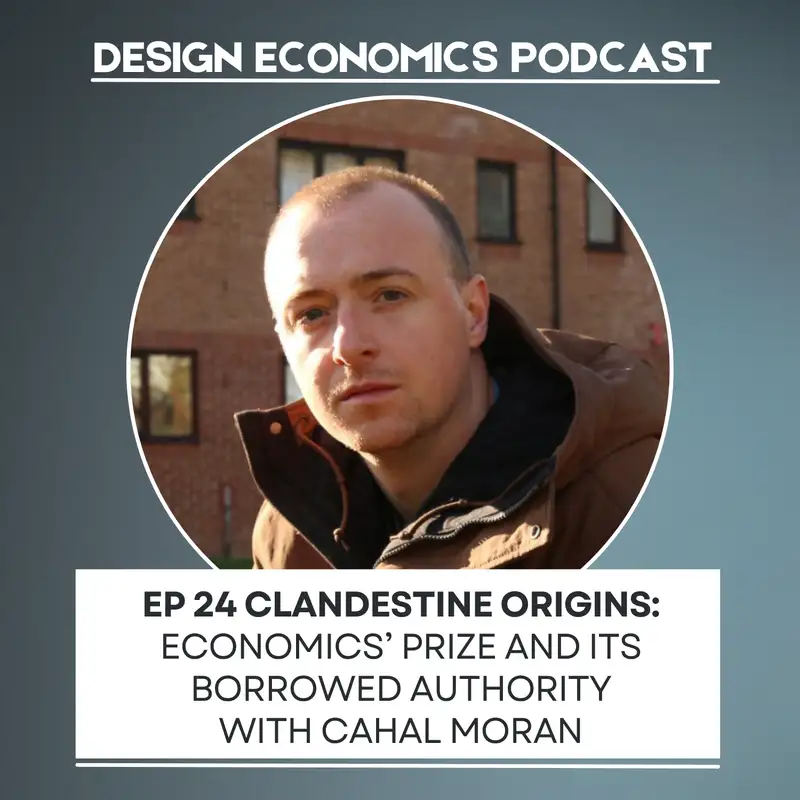
Cahal Moran: Clandestine Origins; Economics' Prize and Its Borrowed Authority
For nearly 60 years, October headlines have announced the "Nobel Prize in Economics." Alfred Nobel never created one. Sweden's central bank simply invented it in 1968, borrowing the Nobel name and the authority that came with it. Just six years later, winner Friedrich Hayek warned the prize would confer "an authority which in economics no man ought to possess," then accepted it anyway. Days after this year's award, host Vinny Tafuro sat down with Cahal Moran, economist and host of Unlearning Economics. Unlike the Nobel Prizes in physics or chemistry, Cahal argues, this prize rewards no discovery, yet gives its winners real and undemocratic influence over policy. Their conversation explores the prize's dodgy origins, who it elevates, who it almost entirely leaves out, and why it perhaps shouldn't exist at all.
Guest Links
Guest Links
- Unlearning Economics on YouTube
- Why We're Getting Poorer: Economics for an Unfair World, Cahal Moran (2025)
- Why You Should Ignore the Economics Nobel Prize, Cahal Moran, IAI
Referenced in this episode
- Rethinking Economics
- 2026 Sveriges Riksbank Prize announcement, Robert Hall and Michael Woodford
- Swiftynomics, How Women MasterMind and Redefine Our Economy, Misty L Heggeness
- Who Cooked Adam Smith's Dinner?, Katrine Marçal
Referenced Design Economics Podcast Episodes
- Episode 19: Misty Heggeness on Swiftynomics
- Episode 20: Erin Hotchkiss on Fragments & Frameworks
A note on black holes: The famous first photo of a black hole, mentioned in the episode, came in 2019 and did not win a Nobel. A year later, the 2020 Nobel Prize in Physics went to Roger Penrose, Reinhard Genzel, and Andrea Ghez for proving black holes are real, including a supermassive one at the center of our galaxy.
★ Support this podcast ★
★ Support this podcast ★
Creators and Guests
Host
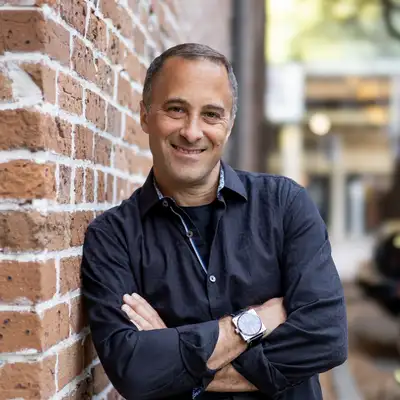
Vinny Tafuro
Vinny is a visionary, futurist, writer, entrepreneur, communications theorist, and economist. A polymath and curious by nature, he is a pioneering advocate for the twenty-first-century economy that is disrupting society’s rigid institutions and beliefs. Vinny’s economic and foresight projects explore the societal and economic shifts being catalyzed by human culture as a result of technology, corporate personhood, and evolving human cognition. An engaging and energetic speaker, Vinny presents on a variety of topics both professionally and through community outreach. He enjoys an active and blended professional, academic, and personal life, selecting challenging projects that offer opportunities for personal and professional growth. He is the author of Corporate Empathy and Unlocking the Labor Cage.

Guest
Cahal Moran
Dr Cahal Moran is a behavioural economist who is interested in understanding the impact that behavioural heuristics and biases have on our decisions in the real world. In practice, this means looking at household datasets to try and tease out the various nuances and asymmetries created by the quirks of our behaviour. Cahal is especially interested in the economic effects of these behavioural quirks, such as their consequences for earnings and savings. For example, his PhD thesis measured the causes and consequences of reference points for household behaviour with the aim of contributing to the field literature on prospect theory. One of Cahal's papers looks at asymmetries in savings behaviour and whether or not these can be attributed to loss aversion. Since his PhD, Cahal has expanded his research to look at the impact of different biases on the behaviour of different groups. For example, he is currently working on a project which investigates the impact of choice overload on charitable giving among committed philanthropists, and preliminary results suggest that more choice actually encourages donations, which is contrary to choice overload. Joint work with Dr Ganga Shreedhar from PBS shows that the UK Government's much-vaunted High Speed Rail 2 policy likely resulted from overly optimistic cost-benefit analysis. Cahal is also a passionate advocate of economic pluralism and has long been a member of the student-led campaign Rethinking Economics. His book The Econocracy summarises their argument for pluralism and the importance of economic ideas in contemporary society. Cahal's latest book, Why We’re Getting Poorer, analyses and explains issues such as inequality and cost of living crisis from a pluralist perspective. Finally, Cahal's YouTube channel Unlearning Economics provides similar commentary on things that interest him.