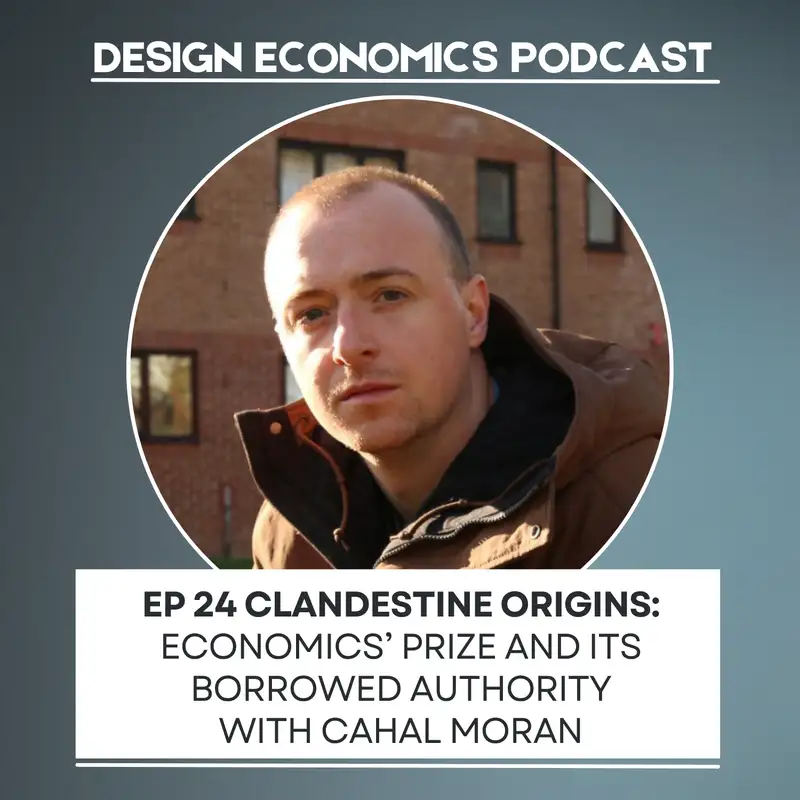
Cahal Moran: Clandestine Origins; Economics' Prize and Its Borrowed Authority
Don't think you can ignore it, right? We're talking about it now. You can't ignore it. I don't think it should exist because a prize in physics is like, we've discovered this thing about reality, but a prize in economics gives you power over the policy process, which should be a democratic matter, right?
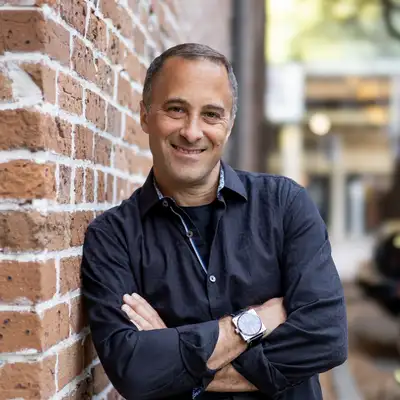
Vinny Tafuro:Hello, and welcome to episode 24 of the Design Economics Podcast, where we explore how design thinking driven by data is revolutionizing economics for the twenty first century. My name is Vinny Tafuro, a futurist economist, and your host for this episode. This is a bit of a different episode. Every October, the world hears that someone has won a Nobel Prize in economics, but Alfred Nobel never created this award. His will established just five prizes, first awarded in nineteen o one, physics, chemistry, physiology or medicine, literature, and peace.
Vinny Tafuro:They're announced in the week before the economics prize culminating with the Peace Prize on Friday. In 1968, Sweden Central Bank marked its three hundredth anniversary by creating a new award, the Sverius Rixbank prize in economic sciences in memory of Alfred Nobel. It borrowed Nobel's name, the Nobel ceremony, and most importantly, the Nobel Prize's prestige. At the time, economist energized by advances in science saw the award as an opportunity to convince the public that economics was a hard and complex science based entirely on math. An award to set economics apart from sociology, history, and philosophy, the very fields that explain the society that every economy is built on.
Vinny Tafuro:The plan worked. Today, journalists, authors, and even economists almost never make this significant distinction. They simply call it the Nobel. And every time they do, that borrowed authority grows. A quick word upfront.
Vinny Tafuro:Parts of this conversation get dense and briefly get into the weeds. I'm asking you to trust me and stay with it. What you'll hear is rarely said outside the field, how economics came to be the way it is, and why so many of us are made to feel it was beyond our comprehension. My guest today has been asking these questions since he was a student. Cahal Moran started studying economics just as the financial crisis of two thousand eight hit, and he watched his professors teach models that had just failed.
Vinny Tafuro:A few years later, he helped found a student movement that became rethinking economics. He went on to earn his PhD, teach, and then left academia to reach the public through his YouTube channel on learning economics. I found Cahal through an interview he gave this summer about the prize, and we recorded this conversation just two days after this year's award was announced. Before we begin, if you find value in these conversations, please consider supporting the Design Economics Podcast through our Patreon at patreon.com/evolveeconomics. And with that, I hope you enjoy this conversation with Cahal Moran.
Cahal Moran:A pleasure to be here. Thank you so much for inviting me.
Vinny Tafuro:So, I had found you through an article you wrote about ignoring the Nobel, and maybe if you could first go into a little bit about your background and what brought you to where you are today in unlearning economics.
Cahal Moran:Yeah, so I started studying economics in around the start of the great financial crisis, which was obviously a major economic event, and I remember picking economics just before it started, you know, when I was 16 and I was curious about the subject, but then this crisis hit pretty much I think in my first lessons. It was September 2007 and the banks were looking they were gonna collapse and my economics teacher said, well, know, it's gonna be a terrible thing. This is gonna be a really bad recession, but it's a really good time to study economics. And so I sort of took that to heart and I ended up pursuing it to university and getting a doctorate in it and becoming a lecturer in it. And I guess I was just motivated by this massive, you know, catastrophe, catastrophe, really, and what it revealed about the economics profession and how they seemed not really to have foreseen it, how they seemed to have not really understood it or where it came from, how people didn't really seem to know what to do about it, and we seem stuck and you know, it would be one thing to say, well, the great financial crisis happened and we learned our lesson and we had a really solid recovery and now we're sort of moving on, but that's not what happened, is it?
Cahal Moran:You know, to phrase it in my early teacher's terms, I think the past decade and a half has been a very good time to study economics. It's been we had austerity in The UK which was completely the wrong decision and it really set us back. We had Brexit in The UK which I think was also the wrong decision and also set us back. And then globally, you know, we've had the rise of the far right. Everywhere had a slow recovery.
Cahal Moran:The Eurozone also had austerity, very slow recovery. Greece, you know, for instance, is just completely unrecognizable from where it was and Italy probably not quite as bad, but almost as bad. Their economy has been stagnant for a long time. So this is really something that was shared across the globe, this very slow recovery, a lot of negative policy decisions and the rise of populism, particularly the far right. And then of course we had coronavirus, as if that all wasn't enough, and lockdown, and then we failed to recover properly from lockdown.
Cahal Moran:We had the cost of living crisis, the supply chain crisis, and we've had the return seemingly. You could argue whether it's really a return, but we've had the return of major wars and major worries about the international stage and global powers and things like that. It just seems it's one thing after another. We have a generational defining crisis every couple of years now. I really, my mission And
Vinny Tafuro:you've had enough.
Cahal Moran:Yeah, I know, I know. I've had enough of talking about it even, but it's just my mission is really to try and make sense of all of this and try and help people to understand it. And that's why, you know, when I went through all my studies and everything and I used to teach and research and I still do those things to an extent, but I started my YouTube channel in early COVID and it just sort of took off and went really well and now I do it full time because you reach a much bigger audience, people who don't necessarily know about economics and are willing to learn and you get to cover whichever topics you want and whichever topics matter to people. And so that role is really something of public communication. It's really another thing the economics profession has failed at.
Cahal Moran:They're not unique in that. Academics are generally bad at public communication, but I guess that's everything that happened in my life up until this moment.
Vinny Tafuro:I appreciate the concise history there, it's a full one too, because I know my own journey. I was definitely in a solid part of my career when the financial crisis hit, and everything was turned upside down. My previous career was website design, and I saw the automation happening that was going on as things were being digitized. And it was really in the wake of that here in The US with the Occupy and Tea Party movement, is really where my economic awareness started to rise. I was like, what's going on?
Vinny Tafuro:And that actually inspired the first book that I wrote on corporate empathy. Was like, why when we start a small business is it warm and cuddly and does good things? And then when it becomes big, it has to become a sociopath. And I'm like, where where did this come from? And that was really my first curiosity into it around that same time that you were doing this.
Vinny Tafuro:So let's get, you know, into the first thing of of what happened this week and and and the kinda state of what what the two winners were. It was, I think, you know, Robert Hall and Michael Woodruff from Stanford and Columbia won the award. And can you kinda maybe describe a little bit about what they won and why?
Cahal Moran:Yeah, yeah, Michael Woodford. But he, yeah, so they're macroeconomists. Now, disclaimer that my field, I'm not a macroeconomist, but I have, you know, learned, I've done quite a lot of macroeconomics courses and I retain an interest in that field because it is the one that was implicated in the two thousand and eight financial crisis and it's the one that's probably the most important to most people, you know, how is the economy doing? Unemployment, growth, inflation, interest rates, all of these things. Those are what people probably think about when they think about the economy, what they see in the news.
Cahal Moran:So macroeconomics is arguably the most important field, subfield in economics. And yeah, it's really interesting to me, this prize. So it's probably worth going into a little bit of background. I think that if you look at, say, the physics Nobel or the chemistry Nobel, what you'll often find is that the scientists have discovered something about reality. So the one that sticks in my mind was I think 2020, the physicists that they took that first photo of a black hole.
Cahal Moran:Mhmm. If you remember that one, and it was this kind of blurry photo, but it was amazing in science terms, you know. It wasn't that much to look at, but it was so hard for them to to actually get that photo. And so it was it was incredible. And that's we did this thing.
Cahal Moran:We discovered or observed this aspect of reality. We received the Nobel in the subsequent couple of years. The Econ Nobel is very, very different to that. It's really retrospective reward for a lifetime of research. So if you look at these two guys, they're past their primes.
Cahal Moran:Think Robert Hall's quite fairly old. I think Michael Woodford's a bit younger, but they're sort of probably their best research output is behind them, and it's this, Oh, you've done this for the field. So it's just very different because I don't think social scientists really discover things about reality in the same way. I don't think there's a fixed reality waiting out there for us to observe. It depends on our theories about it and what we're observing and what happens in any given time and place.
Cahal Moran:So it's not like they discovered recessions or something. You know, it's not that simple. So the reason I'm saying that is because what they engaged in was actually quite a complex kind of theoretical constructs that were really instrumental in bringing micro foundations to macroeconomics. So what that means is that if you take macroeconomics as what I just said aggregates, GDP, unemployment, inflation you can think about it in a really sort of simple, reduced form way where you're like, if inflation is higher, unemployment will be lower. If unemployment is lower, GDP will be higher.
Cahal Moran:These kind of basic relationships between aggregates. And economists did that for a bit, but they weren't really happy with it because they really want to be able to build up their models from individual behavior. So there's been this mathematical streak in economics for a very long time, building up the entire economy from models of individuals optimizing. Individuals maximize utility, which is some measure of preferences and satisfaction. They buy the things that they want the most.
Cahal Moran:Firms maximize profit, of course. Governments or central banks might maximize some other sort of social aim, and there are various iterations of all of those, and they interact through the market, all of these economic actors, and you get the sort of the outcome, you know, how much is employment, how much is inflation, how much is GDP. So there's this drive to build up the whole economy from micro foundations. And when economists were just doing it with aggregates, they felt that that was very unrigorous and it was too well, those relationships are kind of subject to change. It's not like inflation directly acts on unemployment.
Cahal Moran:Those aren't agents. They don't do anything. They just they just are measures, constructs. So there was this, it sounds a little bit sensible. You can understand why they're interested in what's underlying, what's underpinning these aggregates.
Cahal Moran:You can understand that. I completely get that. But what they engaged in was basically this quite restrictive program of bringing a certain type of modeling to rationalize, I think, what were, in many cases, already preexisting policies. Yeah. So Michael Woodford in particular...
Cahal Moran:Sorry, were you about to say something?
Vinny Tafuro:No, and I don't wanna get too into the weeds of what it was, because it's really one of those things, and this is, I think, the challenge with this award, the way it's placed, the way it's named, and what it's done for the field, is when you describe something, No, I have no idea how the photo of a black hole was taken, but the average person who has understood since childhood that they might get swallowed by a black hole understands how awesome that is to have done it. I look at it, think the headline with this year's award was for your work in the stabilization of economies, That sentence, said this week, in an award for a lifetime of work on stabilizing economies, does not make nearly as much sense as, We photographed a black hole. And I think that's...
Cahal Moran:That's such a good way of putting it.
Vinny Tafuro:That's a challenge.
Cahal Moran:I think that... So there was actually a physics Nobel Prize winner at Manchester, which is where I studied, and he won it, I think, while I was there, and he gave a public lecture. And he won it for graphene, sort of a graphite derivative, which is what's in pencils. But it's basically, it's very sharp at the microscopic level. And when he was explaining it, excuse me, when he was explaining it, he was saying well, it's basically just sharpening a pencil, but just in a really, really microscopic fancy way.
Cahal Moran:And it's, oh, I understand that. I understand why that's useful. I couldn't do the maths. I couldn't do it. Of course, I know I couldn't.
Cahal Moran:But yeah, it just speaks to the fact that for really for economists, I think what I was getting at is the prize only really matters to economists. The economy matters to people, stabilizing the economy matters to people, but really, we had all these ideas about stabilizing the economy already and then they came along and they micro founded them. What does that mean to people? People don't really care that much about these theories and whether they cohere with stabilizing the economy. They might only care if the economy is stable.
Cahal Moran:Now, when you said this, that forced for economic stabilization, it also reminded me of another point, which is what stabilization? What are you talking about? I started by talking about the two thousand and eight financial crisis. It's so funny to me because macroeconomics was so thrown into disrepute. And now I just feel the Nobel Committee are taking the piss a bit because they're like, oh, we're gonna...
Cahal Moran:Because they gave it to Ben Bernanke as well a few years ago. And they just, oh, let's just give it to all the macroeconomists now. And I I just don't understand. These models were very much implicated in the two thousand and eight financial crisis. A lot of them didn't have the financial sector in it.
Cahal Moran:Economists weren't looking at house prices or the housing bubble. They didn't really mind about what was going on in investment banks in terms of all the securitization, the repackaging of mortgages, all that kind of stuff. It wasn't really on economists' radar. They tried to retcon it and say it was. It wasn't because if it were, then if it had been, then they would have seen it coming in some way, shape or form.
Cahal Moran:Everyone was very surprised by it. And this is the type of model that Michael Woodford built. So it is strange to award not just... It's twofold. They were awarded it for doing something that only really matters to economists, I think, the theory, but also for macroeconomic stabilization, which does matter to people, even though they might not know what it means, but then in a period of instability.
Cahal Moran:So it's a very odd award. I
Vinny Tafuro:agree. And I kind of... With this... In kind of taking this in paradigm change, which is our first tenet in design economics, is this idea that acknowledging that paradigms change. And I think a little bit of history is probably we could get into of the award itself, and the fact that, you know, there were five original Nobel awards, and it was only in 1968 that this one was created.
Vinny Tafuro:And so, I don't know how much background you have on that side of it, or just the reality of that it was the Swedish central bank that created the award as a celebration of its three hundredth anniversary. And so what was happening in economics in the late 60s that warranted the creation of this award and placing it in that high of a prestige?
Cahal Moran:Yeah, it's really interesting, depending on how you view the whole thing, can view it as a little bit dodgy and clandestine. Mean, the Swedish Central Bank actually, they finance it themselves in the sense that they do modern monetary theory. I don't know if your listeners know about that, but print money themselves, the central bank, sanctually, to The same
Vinny Tafuro:way point the US central bank does.
Cahal Moran:Yeah. Yeah. The Federal Reserve does it.
Vinny Tafuro:They think
Cahal Moran:we can't QE do Or do that of nothing. Yeah.
Vinny Tafuro:Yeah.
Cahal Moran:Yes. QE. Yeah. That's much more restricted. This is quite random.
Cahal Moran:Also, why the Swedish central bank? You know what I mean? The Swedish central bank created this award out of nothing. They make the money to award it. But yeah, so over this period, to return to the sixties, you're talking about a period of formalization and professionalization in the economics profession.
Cahal Moran:You're talking about America really coming to dominate the profession, whereas before it'd been more European, maybe The UK was dominant, but also there was quite a large presence of the German schools as well, the German historical school it was called.
Vinny Tafuro:I'm familiar with the switch from Keynesian, Cambridge economics towards Chicago school neoliberalism was kind of how I understand that transition period.
Cahal Moran:Yeah, that's more... So, yeah, let's delve into that. So I think there's two different things here. There's methods and there's implications or policy recommendations. Now, one thing that happened was Keynes actually wrote his general theory in the '30s after the Great Depression, very comparable to the Great Recession, albeit worse in, well, certainly in The USA.
Cahal Moran:So Keynes wrote his book that basically said recessions and underemployment, unemployment are standout features of capitalist economies. The norm is actually for there to be unemployment, which went against these kinds of models that where everything sort of settles in equilibrium and markets are optimal and blah, blah, blah. And so then Cahes writes his book and it's kind of hard to deny at the bottom of the Great Departure, I think it was released in 1936. You're talking about things have been going really badly for a really long time for a lot of people. And he basically said, maybe macroeconomics exists.
Cahal Moran:Maybe we need to think about the economic system as a whole, these aggregates, what are
Vinny Tafuro:the Not just we the pieces of it.
Cahal Moran:Not just the pieces of it. You can't just say, oh, a business is going to behave this, and then extrapolate that out to the whole economy. There might be sort of coordination problems or, you know, if everybody sort of saves at once, then it's gonna depress the economy even though saving is good for an individual. Blah blah blah, you know, those kinds of aggregate paradoxes. So he wrote his general theory, and then eventually after two wars and the depression, the profession and the world was forced to accept, okay, maybe we need some government stabilization policy and what is an unstable system.
Cahal Moran:So that's when we had things like the Bretton Woods system of currency management. We had very active government policy in terms of government spending to try and ensure full employment following Cahal's lessons. But one of the things that happened at the same time, kind of alongside this, was the increased mathematization of economics. So economists had been using math since the late nineteenth century, but there were sort of multiple ways of doing things. And if look at Cahal's, the actual book, it's got some maths in it, but it's not really, it's mostly prose and a lot of economists knew how to write back in those days and they didn't just use maths, and Cahal spoke out against excessive use of maths.
Cahal Moran:So there are a whole bunch of different approaches, but the mathematical approach really centered on America, on American universities just took over after World War II, and Paul Samuelson, who considered himself a Keynesian, who believed in Keynes' lessons about the Depression, who presumably grew up in the Depression, so he wasn't about to say Keynes was completely wrong, but he formalized all of this. So you get all these mathematical models of Keynesianism emerging, which aren't really what Keynes wanted. He was more
Vinny Tafuro:of a philosopher from One of the early things that I really read of his incomplete was his letter in 1930 about the lives of our grandchildren, and the idea that automation and production would increase, and we would work a lot less a hundred years from now. And here we are, we're coming up on, in four years, it'll be that hundred year mark. Yeah, we're nowhere near the vision he had, yet we're talking about it because you get the billionaire class in The US talking about how we may need a universal basic income because Elon Musk's robots are gonna be doing everything for us. Gotten this kind of... We had this kind of philosophical look, the math side of it, I think I forget who it was.
Vinny Tafuro:There's an organization, the Institute for New Economic Thinking. Yes. But it was one programs of their that I watched on their YouTube channel. It was about how economists would rather be precisely wrong than broadly correct. And they said it was just because the maths are so perfect here, but then when they get to the real world, they may not work.
Vinny Tafuro:And I think that's part of that disconnect of treating the field like this science that's math based, when it really is what do we believe as a society we should be doing with our time, energy, money, and resources? Is that a disconnect that we have?
Cahal Moran:I do think that quote was originally Cahal's as well.
Vinny Tafuro:Oh, really?
Cahal Moran:Most good quotes in economics are just Cahal's. He also talked about getting lost in a maze of pretentious and unhelpful symbols. So, I do think that economics has lost that kind of broader, more holistic, more eclectic approach. Cahal has also said the great economist must be a historian, a mathematician, a philosopher to some degree. There's a really good quote from him where he elaborates on, An economist had to be all things at once.
Cahal Moran:You have to have knowledge of various different areas of life. Instead, in this postwar period, Keynes died in 1946 as well, economics just became the maths, and economists weren't really permitted to make philosophical or even methodological reflections. They just really had to solve the model and if something wasn't believed unless it was in a model or perhaps with statistics and there was little qualitative or historical knowledge either. That wasn't regarded as valid knowledge. So this was a professionalization period and Keynes fell out of favor during the 70s when we had stagflation and wage price spirals and all of that in The US and UK and in some other countries, and it was thought that the government spending too much money would basically lead to this kind of inflation, and there were various reasons that economists came up with for that and I think it's still contestable to this day what exactly happened in the 70s and why.
Cahal Moran:But they settled on basically we need to return to these micro models. We need to return to these micro founded models because what was happening was that individual decisions adjusted in response to government policy. And I think to put it kind of crudely, Nobel Prize winning economists have said this, they basically thought that government spending was kind of inflationary, and it was kind of false, and you could trick people by spending to create employment in the short term. In the long term, they would realize and basically adjust their behavior, and you'd have no real increase in output. And if you wanted actual increases in output in the long term sustainable ones, you needed to go for supply side or free market reforms.
Cahal Moran:But the way they proved this was through this mathematical micro foundations project of bringing back the optimizing agents and the equilibrium, which the Keynesian models didn't really have. So you get... You were talking a little bit about this free market versus Keynesian thing, and I was talking about this mathematics versus non mathematics thing. Well, their paths have overlapped. Then with this micro founded project, they came together and you had micro founded models that were deeply free market and implied that the government should never intervene.
Cahal Moran:Now, this, you said you didn't want to get into it too much, but this is roughly when Woodford and Hall enter and they start changing things again.
Vinny Tafuro:Yeah. In going into how to understand this, the award started rewarding a smaller and smaller type of thinking of economics that used math. When you look at the numbers with the Stanford winner this year and one more from Columbia, you look at it. Chicago has won 15 of them, MIT 10, Harvard eight, Stanford six, and now Columbia has five, which is where Stanford was last week. And so you have five universities who have won 44 out of 101 of the awards, and 44% of the awards.
Vinny Tafuro:So, it's been very obviously, as much as it was a Swedish central bank prize, it really has been taken control of, it seems like, by four or five universities that have had such an outsized influence on it. That, number one, in your article that you wrote about ignoring the Prize, and also your work in unlearning economics, and I think you were involved with rethinking economics, How does what that award has done to the field and your work in creating these platforms for people to understand in more general terminology what is going on?
Cahal Moran:Yeah. I think it's funny with the Nobel, I think they interpreted me as saying, You should ignore it. I don't think you can ignore it. We're talking about it now. You can't ignore it.
Cahal Moran:I don't think it should exist simply for the reason that no, you know, a prize in physics is again, we've discovered this thing about reality, but a prize in economics gives you power over the policy process, which should be a democratic matter. And so I actually think something similar about the Peace Prize. I don't think the Peace Prize should exist either because I think that it has outsized influence. So I don't think it should exist. And the problem, obviously, you know, there's an intrinsic problem, but there's also this issue of how narrowly it's been awarded.
Cahal Moran:You said five universities, not even just The United States, but five universities in The United States have received half or around half of the prizes. You said 44, I think. So I think the total award is probably 110 people. So it's about half of the prizes awarded to a select group and they all agree with this formalized mathematical tradition. And if you look at individual universities, obviously Chicago has a reputation for being very, very free market and neoliberal.
Cahal Moran:You've got people like Milton Friedman, Robert Lucas, Friedrich Hayek there, all Nobel Prize winners all at Chicago. And then on the other hand, you've got places like Princeton maybe, what's called the saltwater freshwater divide. So I think some of the universities that are on the lakes, the Great Lakes, tend to be more free market and some that are on the Atlantic tend to be more Cambridge.
Vinny Tafuro:I have seen that. It's there's a little bit of a Cambridge type of on the MIT Harvard corridor right there. I mean, they're blocks away from each other.
Cahal Moran:Yes, exactly, exactly. So what I'm getting at is each university does have its own traditions. When you go to a university because you want to study a certain area, if you choose a supervisor, for instance, for your PhD thesis, you'll be like, Oh, this is a good place to go because they have a long history of doing game theory or blah blah blah. So yeah, that obviously, therefore, that is going to narrow the range of kinds of economics and theories and findings that are awarded the Nobel Prize and therefore give these groups outsized influence over not just The US economy, but the global economy because policymakers and politicians and the media are going to listen to them. You know, saying we've got a Nobel Prize winning economist advising us, obviously that carries quite, that carries a great degree of weight.
Cahal Moran:You see it all the time. You see it all the time. So this is just fundamentally, I think, quite an anti democratic process. And it is worth also saying, you know, regardless of whether it's The US or UK or whatever, you know, if you look at the demographic composition of the prize winners, I think three or four women have ever won it. Yes.
Cahal Moran:100 men, three or four women, and three or four non white people. It's just that's very, very narrow. And the profession has historically neglected issues of race and gender, as you would expect if you just awarded it to one group of white dudes.
Vinny Tafuro:Yeah. You're the second economist we've had on this show. The other one wrote a book in The US called Swiftonomics, Misty Hegsenth, and has really worked... She's in the economics department, but really she's been working on feminist economics, that...
Cahal Moran:What is in Taylor Swift economics?
Vinny Tafuro:Taylor Swift, yes.
Cahal Moran:It's Why about not read this book? I love Taylor Swift. Okay. Oh,
Vinny Tafuro:you gotta check it out. It was a great book. Absolutely. Wow. And I did not realize how many of Taylor's songs were about historical women, and kind of the challenges or things they did.
Vinny Tafuro:She's actually, through her music, teaching history lessons. And we also, we talked about Frances Perkins quite a bit, the first female women's secretary of labor under Roosevelt here, and the longest secretary of labor in history, because she brought it, she was here for social security and all those programs. But yeah, Swiftonomics, it was an amazing read.
Cahal Moran:Like to What's Swift the only good that? I like to call call Taylor Swift the only good billionaire.
Vinny Tafuro:I can agree with that. I can agree
Cahal Moran:with that.
Vinny Tafuro:So, the thing is with this, and you got into it a little bit there, of the award even existing. The thing is, the Peace Prize, you can have a problem with it, but at least it's understandable that the Peace Prize is subjective, the literature prize is subjective. I think what's happened with the way the Swedish Bank Prize has been positioned itself as a Nobel, the average person is really kind of what you said earlier about Clandestine. It's a little bit of like, I'm going to assume this is a science, and I use this even yourself earlier in the conversation. You said, I'm not a macroeconomics, but I've read enough about it to have an opinion.
Vinny Tafuro:And what I find here, and I use this in The US as an example, if we have a Supreme Court decision on abortion, I don't care what background somebody has, they're going to give you their opinion. Nobody is going to say, I'm not a constitutional lawyer. Here's my opinion. And you have to pass a bar. There's a certain professional level to become a lawyer, and economics, it's the one place that even a lawyer will say, I'm not an economist, but here's my opinion.
Vinny Tafuro:Does the field deserve that kind of prestige?
Cahal Moran:Well, no. It's really interesting because it's a bit like, I'm, you know, I'm not a chef, but I can tell you that the steak tastes terrible. You know, I'm not a train driver or engineer, but I can tell you it wasn't on time. And I think similarly, I'm not a macro economist, but I can tell you that the macro economy has not really gone very well for quite a long time. I can tell you when it's crashed.
Cahal Moran:I can tell you when you're best up. So it is totally true that we all deserve to have democratic input into this, whether we're economists or not, whether we're macro economists or not. I completely agree with that. And their reputation, I think, is earned. You know, just not really making correct predictions and not really contributing useful knowledge.
Cahal Moran:I mean, a lot of the time, it's just this kind of combination of either statements which are false or statements which are quite obvious, they've got lots of fancy theory to prove it. So, yeah, maybe they don't deserve that much deference.
Vinny Tafuro:Well, in that, let's move on to how do we teach better literacy about economics? And I think this is your work. If you can go into rethinking economics a little bit, because I had come across that, and I'm looking forward to learning more about rethinking economics, but also your YouTube channel. How do we get these messages out there to kind of change that conversation?
Cahal Moran:Yeah. So I think that it is important for anyone who has any sort of economics training, whether formal and official or you're just self educated or whatever, if you're confident on it and you're interested in it, I think that it's important to try and make some effort to communicate it through some kind of forum whether that's social media and video or podcasts or you're just talking about delivering some kind of classes or workshops or even just everyday conversation and just being happy to explain it and talk about it because I think it does matter to people. And when I say I'm an economist and stuff and start to talk to people about it, can open up about their own sort of lives. People will be, oh yeah, it's really hard, my job's really hard, interest rates have gone up, what's going on? And everybody is prepared to have that conversation in principle.
Cahal Moran:They just might need a little bit of nudging because economics feels a really technical subject and sometimes it is, but I think you can explain most of it, not all of it, but most of it, most of the stuff that matters to people in relatively plain language. And this is one thing you mentioned rethinking economics, they've been really committed to doing this, getting the message out there and trying to equip people who know about economics to be able to communicate and talk about it more.
Vinny Tafuro:A little bit maybe on unlearning economics, I'd like to get people to go there and check it out. We'll put that on the website if there's anything you want us to share there as well.
Cahal Moran:So, yeah, my channel... So I actually started unlearning economics as a blog when I was a frustrated undergraduate, and this was when I was just learning these models and thinking, what the hell is going on here? Why are we learning this? It was Greece was literally on fire at the time. We're talking Eurozone crisis.
Cahal Moran:Didn't get a mention in our class. We were just learning diagrams and models I wrote. It was absolutely insane. It was really, and we were all asking where is the economics in our economics education? And that's where rethinking economics came from, actually.
Cahal Moran:So that was when I started writing this Unlearning Economics blog and it was just rants of a frustrated economics undergraduate really, and me going into a lot of detail and critiquing some of the theories that I was learning about and I guess unlearning them. But I think unlearning is more than just ranting. I think it's about this doctrinaire idea of economics. So you said people don't feel confident talking about the economy. I think one of the reasons is this thing that I call big E economics, is very much like the economy works a certain way, there's nothing you can do about it, it follows certain rules and laws, and if you don't understand them, that's your problem.
Cahal Moran:You can't go against them. And you see this all the time. Typically, it's used to justify what I would consider free market or more right wing policies. You can't increase the minimum wage. That goes against the market.
Cahal Moran:So you're just gonna create unemployment. You have to have free trade, for instance. But yeah, you also see it used by some people on the left sometimes, Paul Krugman, for instance, or remainers in the Brexit referendum were typically accused leavers of being economically illiterate. So it gets you bandied around quite a lot, but just it's not, economics is not a certain subject. It's very uncertain.
Cahal Moran:Any actual attempt to understand anything in the real world as complex as the economy is going to be hugely contested. Any kind of event, does free trade create jobs or does it reduce jobs? And that is just a very difficult question And
Vinny Tafuro:to both sides of that can be true.
Cahal Moran:Both sides of They that can both be be true. Yeah, of course, of course, yeah, for different groups.
Vinny Tafuro:I remember as a child, my father used to follow the stock market and wanted me to get into it, which is probably why I never did. But I was, I think, in elementary school, and the stock market had crashed. It was what, 'eighty six or 'eighty nine? Crash. I remember as a child going, Why would the economy crash?
Vinny Tafuro:It's just a marketplace. I couldn't understand. I think of a car crash, I'm like, Why would we do this to a market? It's just a place where we sell things. And so, have these understandings that it just doesn't make sense of why we get there, and it seems like we try to get more and more specific, but in doing that, we actually are cementing this idea that it's unchangeable when it actually is very changeable.
Cahal Moran:Totally. The funny thing about stock markets is how controlled they actually are because on the one hand, you think of them as this kind of free market type place where lots of transactions, so billions of transactions take place every second these days. And the thing is, they're so controlled. Firstly, the stock market, unlike other markets, is actually a place or a series of places, you know, in New York, in London, in Tokyo, and it closes. You see people who trade, they'll be like, oh, Tokyo's opening, so this is gonna happen.
Cahal Moran:It's outside of that, it's not doing anything. We don't let it work except outside is ours, and if there's a big crash, there's circuit breakers, so I don't think an individual stock is not allowed to fall maybe 20% within a given day or something. Yeah. Then they'll stop trading. They'll stop trading, exactly.
Cahal Moran:And it's, yeah, we did create this thing and we can manage it. Maybe not perfectly, but we can manage and control it to an extent. And it is weird. You said growing up when your mom's just, oh, well, the economy's not very good at the moment. And you're just, what?
Cahal Moran:Why? Why do you have no influence over that? Why is that just so our lives are just shit for a bit because the economy
Vinny Tafuro:It's is almost like... And I forget what book... When I started reading, we use terminology that we have to feed the market. We we have to... It's almost like weather and god terms for this thing that is just a human invention to circulate goods and services.
Vinny Tafuro:It seems like we've become beholden to that. I guess, how can we start unlearning and really undoing some of the kind of damage that field has done in this? One area I look at, and the reason I bring this up with the awards specifically, is I look at it, and it's called the Nobel, but nobody ever qualifies it to the general public. I believe that's a problem going forward, is whether it's journalists in the New York Times, or it's an economist writing in a book about economics for everyday people, to call it a Nobel without immediately qualifying that it was not Nobel's wishes, that all these things that we've spent the last forty minutes talking about is how do we start doing that, and do we start doing that as a way to make a shift if the field's not gonna do it itself? Is...
Cahal Moran:No, yeah. I think it was always worth noting that the Nobel Prizes existed, and you've got your hard sciences, and you've got your purely subjective ones literature, and you've got your Peace Prize, which is maybe somewhere somewhere between the literature and the economics one. But it's, yeah, it's always worth qualifying that it came along much later, an economist, it has a different name, economist wanted to jump on the science bandwagon at the time they were formalizing. They wanted to reify that and say, okay, now we have our own prize, and it was kind of, it was a little bit of a random thing. So that's worth qualifying.
Cahal Moran:I think more generally though, it's worth qualifying people shouldn't really separate economics and politics, I don't think, and even philosophy and sociology and everything else. But I think people feel they can speak about politics, but maybe not so much they can speak about economics, but they are so hopelessly intertwined. Things that happen in the economy affect politics. Things that happen in politics affect the economy, and the economy is fundamentally the economy and markets are fundamentally political beasts. So that's exactly what we just discussed.
Cahal Moran:We choose to have certain rules for the stock market. We choose to have it on the earth open in certain times and places. We choose to have circuit breakers for it. We choose to have certain laws, and you know, things like intellectual property law, which have really grown and transformed over the past few decades. You wouldn't have the tech billionaires of today without the strict intellectual property laws that we have.
Cahal Moran:Yes. And they didn't used to exist. They didn't used to exist. To get Bill Gates hated it back in the seventies when the internet was open source and he wasn't getting paid. And so he was quite really strongly lobbied for stricter intellectual property laws.
Cahal Moran:And so you have this thing. He's created, kind of created his own economy where he gets rewarded, and at the same time, you might have things like worker protections at the bottom. Some of the people that work for Bill Gates, especially further down the supply chain, they aren't getting treated very well and their protections are being taken away. And that's those are political decisions, but they affect income, industry, they affect growth. So I don't really think you can separate these things and it's about time that people just say, well, no, what earn, my employment situation isn't just ordained by some god called the economy.
Cahal Moran:It is a matter for political contention, and I should be able to fight for a bigger slice of the pie or
Vinny Tafuro:various rights and so on. I've been following Cory Doctorowe, I don't know if he's familiar, in shitification. He was on a colleague's podcast earlier this year, Team Human, and was talking about I I the... Believe it was the policy for protecting CDs and VHS cassettes from being sold overseas is the same backdoor to why I have to buy a subscription to my printer ink forty years I cannot get free market printer ink. I have to buy it from the supplier.
Vinny Tafuro:And if I don't, they have a kill switch on my printer, and it becomes a deadweight. These are political decisions that immediately impact the economy. And I think you don't usually have... Look at... Gonna use the medical prize.
Vinny Tafuro:It was just in 2023, a previously unfunded, unrecognized work of a woman was recognized because she came up with the baseline for the RNA sequencing for the vaccine for COVID. So you go, Okay, we started this with part of these crises. COVID-nineteen, twenty twenty pandemic shutdown, 2023, there's a Nobel Prize in medicine for a vaccine that saved millions of lives. That translates... But for some reason, we are more doubtful of vaccines in our political world today, even though she should be influencing policy, not necessarily the economist.
Cahal Moran:I totally agree, it just made me think of the fact that at the beginning of COVID, it was really interesting, the narrative that was present for perhaps, let's say, most of 2020 before the anti lockdown and anti vax stuff really started to take hold, which was people were very surprised by what we did to the economy. People were surprised that it was a human creation that we could just switch off. And one of the really big things that happened in the COVID pandemic, which people just have forgotten about, but I can't get over it. At the beginning of the pandemic, I'm wielding my coaster here, every single government across the world said, We're locking down. We're locking down.
Cahal Moran:Everybody stay at home. You can all stay at home and not work for a bit. It's gonna be fine because all your jobs are kind of pointless anyway, which you already sort of knew, but now we're just affirming it. Who's going to stay at work? The essential workers or key workers.
Cahal Moran:So that expression, that phrase, essential workers, as soon as they said it, everybody knew who they meant. It's not really... There's a couple of cases of contention, but generally speaking, of course, they meant bus drivers. They meant delivery people. They meant farmers.
Cahal Moran:They meant doctors and nurses. All the people who bring us the stuff that we actually need to survive and get by, all of those people had to stay at work because otherwise society would actually collapse and the economy would actually collapse. But people like, that includes me, academics and YouTubers, people who work in marketing, hedge fund managers, a lot of people who actually are paid quite a lot. Essential workers earn less on average than the rest of, than other workers, with the exception of doctors. So we remunerate them worse, but we recognize that they're the people who keep society going during early COVID.
Cahal Moran:Then we forgot that and it all became about anti vaxx anti lockdown and how we have to get the economy going again, even though we'd just seen that we didn't have to get the economy going again in the same, at least in the same way. We need an economy, don't get me wrong, but not in, we didn't need the economy that we had. We've just proved that we could switch part of it off and we knew who actually mattered. So we... It's crazy how that's just gone to wanton anti intellectualism, and we think that we can dispute vaccines, but we can't dispute the economy.
Vinny Tafuro:Yeah, and I think that's a perfect example. This idea that the care economy, and I think that that's what we have talked about on this program quite a bit, is social sector, the social capital side of this, that economics... If you hire your nanny, you stay at home and take care of your children, it is not a benefit to the economy by metrics. It doesn't contribute to GDP. Your child is not in child labor, and the person at home taking care of them is not contributing to the economy the same way.
Vinny Tafuro:Whereas if you hire a nanny, now the nanny is making money, both parents are in the office making money, and so that's a net plus to the economy. I think this is a disconnect. People don't, you know, it's logical, like essential workers. We get it when people say it, but the economists don't say it.
Cahal Moran:Well, I always think that if you bake a cake then eat it, it doesn't contribute to the economy, but if you bake a cake then sell it, it does. But the act of production is the same, the resources are the same. It's just that one of them is marketized and one of them isn't. This absolutely applies to the care sector and to care work traditionally, you know, cooking, cleaning, transportation, child rearing as well traditionally, or still to this day, majority done by women. Women tend to be neglected in traditional economic statistics for that reason.
Cahal Moran:So yeah, I mean, I don't know how many more economists you want to speak to. Maybe you should speak to Tim Jackson, if you haven't, because he wrote a book called literally The Care Economy. Okay.
Vinny Tafuro:Yeah, I'll at it. Like I said, because I'm trying to bring economists on occasionally. I had a documentary filmmaker earlier this year as well, because it really is, we're talking... A lot of our work is how do we make economics a larger thing, and this was my own experience when I was working on a book and I had reached out to a labor economist. I was like, So what if we expand the definition of labor to include caretaking?
Vinny Tafuro:And I was looking to do an independent study with him in my undergrad, and he looked at me point blank, That's not my field of study, I can't help you. And I'm like, How is changing the definition of labor to include a bigger portion of society not a part of your thing? And it was really where it hit me that just didn't make sense that a labor economist wouldn't be concerned with the expansion of the idea of labor until I learned why he was not interested.
Cahal Moran:Yeah, yeah, yeah.
Vinny Tafuro:Was like, oh,
Cahal Moran:I see.
Vinny Tafuro:That would change your entire background. Yeah,
Cahal Moran:yeah, exactly. It completely reclassifies things. And it's really interesting. I spoke about the dominance of men in economics and white people, and it is really interesting because I think some people might ask, well, does that really matter? Because the economics is the economics and it doesn't matter what type of person is doing it, but it does for exactly the reason you just said, because that dude probably hadn't thought about care really in his life, even though he has received care for his entire life and especially when you're young and old, but also throughout your life, you need some kind of care work.
Cahal Moran:And I also think a lot of jobs entail some kind of care. A lot of things I think we don't usually think of as care can be reclassified as care, to be honest, because ultimately, why are you doing something? You're doing it probably in order to benefit some group of people somewhere down the line, hopefully. So, yeah, it's just that that's a completely different way of thinking about it, and you could say that in principle it might occur to a man, but historically in practice it just doesn't.
Vinny Tafuro:Yeah. There's a book, and I haven't heard back from her. I'm trying to get Catrine Kelos on the show. She wrote a book, Who Cooked Adam Smith's Dinner? Yes.
Vinny Tafuro:Did you read it?
Cahal Moran:No, I haven't read it, but
Vinny Tafuro:I've It heard was super entertaining, because it's very... There's a little snarky, sarcastic, but all this story... Literally, Adam Smith lived with his mother his entire life. He was well off, and he talked about the butcher, the baker, and the candlestick maker, but he never talked about his mom at home cleaning his sheets and his laundry and cooking him dinner.
Cahal Moran:Reframe a lot of these historical thinkers when you realize that they were just over educated, wealthy man babies. Yes. You start to see them in bit of a different light. You're like, oh god, yeah, I'm not sure how much I really like you anymore.
Vinny Tafuro:Yeah, yeah. Well, as we wrap up here, I do... I think you had a book out last year. How can people engage with your work? Know, what would you like to leave people with?
Cahal Moran:This is where if I were competent, I would have a copy of the book with me, but these are all other people's books. So yeah, I wrote a book called Why We're Getting Poorer, which came out early last year, so it's been out for about eighteen months and it's kind of self explanatory. It's the stuff I was talking about at the beginning. We're lurching from crisis to crisis. Things seem to be quite hard for the average person, making sense of it, trying to explain this in a hopefully relatively fun way.
Cahal Moran:There's a lot of sort of anecdotes and cultural references and jokes in it that hopefully work to help digest economics, can be a bit of a tough subject sometimes. So yeah, absolutely read Why We're Getting Poorer and yeah, follow the channel Unlearning Economics. There's a podcast as well of the same name. And I don't know, I mean, I pop up in all sorts of places, I don't know. I random podcasts, I do random talks, so keep an eye out for me.
Cahal Moran:Obviously, the handle's unlearningeconomics. My name's Cahal Moran, which you have to watch out for both of them, so I don't know. Put them in your Google search.
Vinny Tafuro:I'll put them in our show notes as well, and we'll put this out on social afterwards. And, Kel, I really appreciate you taking the time to talk about the award. It's been something... It's it's been on my mind for a while and and wanted to kinda have a a talk with somebody inside the field a little bit on what what it was about.
Cahal Moran:Thank you so much, Vinny. Yeah. It's been really fun.
Vinny Tafuro:We hope you enjoyed this episode of the Design Economics Podcast. If you value these conversations, please consider supporting us through our Patreon at patreon.com/evolveeconomics. Your support helps us continue bringing these important discussions to a wider audience. Don't forget to subscribe to the Design Economics Podcast on your favorite platform. The Design Economics Podcast is produced by the Institute for Economic Evolution, a five zero one c three charitable organization whose vision is economic systems that cultivate rather than restrict our human potential.
Vinny Tafuro:I'm your host, Vinny Tafuro. Thank you for listening.
Creators and Guests