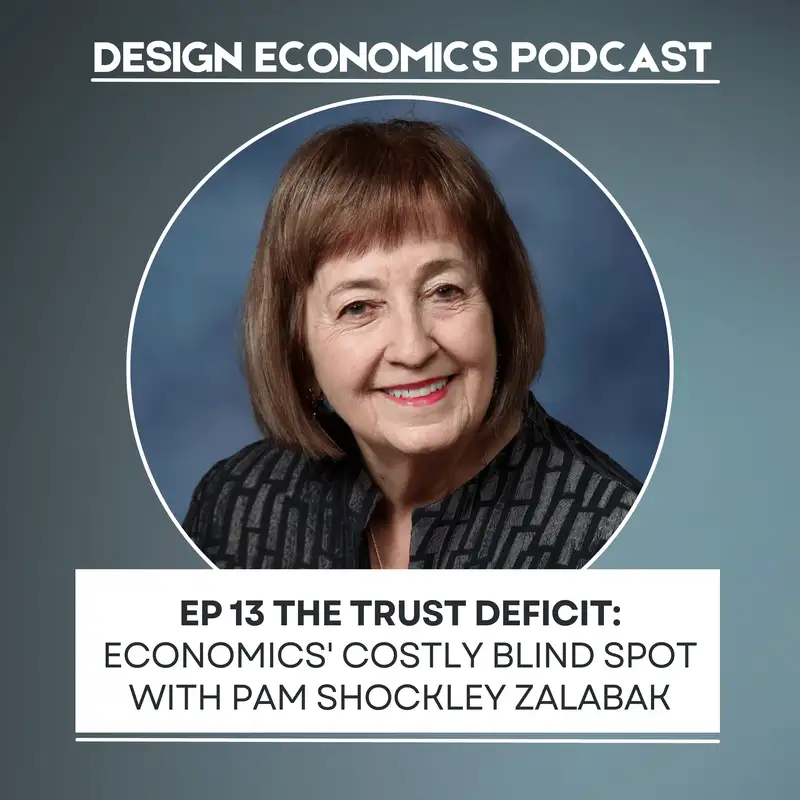
EP 13 Pam Shockley-Zalabak: The Trust Deficit: Economics' Costly Blind Spot
To me, is not an invisible hand. A lot of people think it is. A lot of people still think it's just, it's nice, but it's not necessary. Well, everything we do is about trust. And I'm talking about globally, I'm talking individually, but certainly globally.
Pam Shockley-Zalabak:So I think that our research really makes the argument that social capital is a part of the shift that we must make if we're gonna better understand the economics of the world around us.
Vinny Tafuro:Hello, and welcome to episode 13 of the design economics podcast, where we explore how design thinking driven by data is revolutionizing economics for the twenty first century. My name is Vinit Tafira, a futurist, economist, and your host for this episode. My guest today is Doctor. Pamela Shockley Zalabak, former chancellor of the University of Colorado, Colorado Springs, and a leading researcher on organizational trust. Over her decades long career, Doctor.
Vinny Tafuro:Shockley Zalabach has worked with over 400 organizations across 20 countries, developing a trust model that reveals how economic systems have eroded the social capital necessary for healthy markets and democracies. Our conversation explores the fifty year decline in social trust and why orthodox economics must finally account for its costly blind spot. Before we begin, if you find value in these conversations, please consider supporting the design economics podcast through our Patreon. Your support helps us continue bringing these important conversations to a wider audience. Please visit patreon.com/evolveeconomics or designeconomics.io to learn more about our membership tiers.
Vinny Tafuro:And with that, I hope you enjoy this conversation with doctor Pamela Shockley Zalabach.
Pam Shockley-Zalabak:Well, I'm pleased to be here and I'm eager to have this conversation.
Vinny Tafuro:Excellent. Well, little bit about the Design Economics Podcast. This is our second season or our second year of episodes and we're really trying to tie different conversations to the tentative design economics and this idea of paradigm change, creativity and literacy in economics. And so, I guess maybe, Pam, could you introduce yourself and kind of your background on how you got into the roles that you've done? I mean, former chancellor, doing research.
Vinny Tafuro:Give us a little backstory on on what brought you to where we are today.
Pam Shockley-Zalabak:Well, I'll try to make this really brief, but I went to work immediately upon my undergraduate degree for a company for a highly creative individual who ran political campaigns. But he was organized and he did not get a lot of things executed. And I learned quickly about the media, a lot about politics, about the world around me in terms of getting interaction. And soon thereafter, when I was very young, very young, my business partner and I were given an opportunity to take over this company and manage it out of bankruptcy. My rationale, which was somewhat questioned, but it worked out.
Pam Shockley-Zalabak:My rationale was that we didn't lose the money. So if we could make it work and they were going to give us the stock if we did, then that would be a plus and we were young enough in our lives and in our family situations, but that was a good thing to do. So that's how I got started in really working both in the media and the creative side of working with clients. And part of the assignments that we had at that point was a contract with federal government to teach in federal prisons. And I started my teaching career as a GED instructor for male inmates in a federal prison.
Pam Shockley-Zalabak:I loved teaching. When I had been about ten years into this version of my life, the first part of my life, I really knew how much it was important to go ahead and think about my future in a more organized manner. So I went and got a PhD and applied at the University of Colorado, Colorado Springs to teach. Very tired over the phone because they had just lost an instructor. Went to work two weeks later.
Pam Shockley-Zalabak:They, of course, could fire me if I couldn't do the job because this wasn't a permanent training track. Fast forward many, many years. I became a full professor at the university. And in a set of circumstances with lots of change going on on the campus, six weeks after nineeleven happened, I became the interim chancellor and then the permanent chancellor for over sixteen years. So that's kind of it.
Pam Shockley-Zalabak:I have continued to work in organizations. And my passion for the research I do comes from the fact that I have been in now over 400 different organizations throughout the last many years. And then taking what I've learned in these organizations into the classroom because I love students. So that's it. Kind of a disjointed, non looking for any kind of hierarchical vertical mobility as much as just wanting to make things happen.
Vinny Tafuro:Make things happen and kind of follow the where you're being led I guess a little bit. I prefer curiosity over just following a passion. Passions can be different. It reminds me of a talk I heard a while back.
Pam Shockley-Zalabak:And I think curiosity for me has led to what I've become passionate about. Yeah. There are certain things that I have, where I've done research that I'm, yeah, it's important. It's not where I want to continue what I'm doing. So I, for me, they've been related, but I think curiosity should fuel passion, not passion the other way around.
Vinny Tafuro:Yes, I agree. So in reviewing your work and kind of aligning it for this episode and kind of where we're at with the institute, is you did this research project in 2016 kind of a post election on social trust in that. Could you describe a little bit about that survey and the research that was done and kind of the results of that?
Pam Shockley-Zalabak:Yeah. The research in 2016 was on the Clinton Trump election. And we collected the data nationally. We had enough resources from a grant to be able to collect data in all 50 states. And so we were able to do it at two different points prior to election day.
Pam Shockley-Zalabak:It's been published, of course, after the election. And it was very, very clear. We were using the trust model that had been funded with a team of researchers that I work with in the year 2000 by the International Association of Business Communicators. We developed this model that had been with data from all over the world well, not all over the world, but ultimately in 20 countries around the world and in six different languages. And we wanted to see if this model was primarily about organizational trust could work in the political arena.
Pam Shockley-Zalabak:And we did. And what we found, of course, was that both Hillary Clinton and Donald Trump were not trusted with the general public and that it varied. And the interesting thing that we found in this work is that in those states that flipped the election in the Electoral College, we all remember that Hillary Clinton was victorious by many, many votes in terms of the popular vote. But in the electoral college, her trust profile had changed from our first data collection to our second data collection had lowered. And we analyzed then the campaign strategies in those key pivotal states, which actually dipped the electoral college to the victory that Donald Trump ended up with.
Pam Shockley-Zalabak:It was evident that he wasn't trusted in those states, but he was trusted more than Now across the nation, she was trusted more than he, but neither one of them were trusted. And that has been what is one of the sad for me just as a citizen of this country. One of the sad things about the political process over the last several years, very low distrust in the ability of politicians of any party to actually perform the things that need to get done. And we see that in blocked decision making. We see that in gridlock.
Pam Shockley-Zalabak:We see it in a whole variety of ways.
Vinny Tafuro:Yeah, and as you said, it's been you know a decades long process of kind of bringing us lower and lower on that trust scale.
Pam Shockley-Zalabak:Well it's gone for fifty years has been continuous decline, because these aren't my, I haven't been doing the research for fifty years. I am not young, but I am not. I haven't been doing the research for fifty years. But credible research from Pew and Edelman and other places have been looking at these issues, and we are in a precipitous decline over the last fifty years in this country and in other countries.
Vinny Tafuro:It is, and I so and this is what I really kind of clue me or or really stuck out to me in this and and the research that you did. So you know, we've often looked at you know, like after the nineteen twenty nine crash. The we operated on production before that, but it wasn't until the crash that congress chartered or or or under wrote a report, you know, by by Simon Kuznets at the time to to measure what happened. And we learned through the production of, you know, creation of this new metric that had never been done before of gross domestic product. We learned that the economy lost 40% of value between 1929 and 1934.
Vinny Tafuro:So we operated on on production before, but we had never counted it the same way. I think what happened in the nineteen sixties, you see some of the the stuff that happened like Hazel Henderson is a futurist and economist and she was very much integral in getting at the time Bobby Kennedy to look at pollution in New York and and and the idea that we were impacting the environment whether it was, you know, waterways in Cleveland burning or smog around cities and we really had this this collapse in environmental capital and it's been a fifty year process. It's more. We're still not there in understanding that we can count environmental capital. And what I found wonderful about your research, you know, as we said for fifty fifty years more like trust has always been fragile and especially in a democracy.
Vinny Tafuro:And I think with that shredding of trust over time or erosion of trust over time, the fear, you know, the the recording data is one thing and then you get into 2020 with the pandemic and it's just black and white how in a global pandemic, a nation, a world can't see the same data the same way. And so I think from that, I kinda wanna lead into our first our first tenant which is this idea that paradigms change and economics is very stubborn. We still say there's an invisible hand. My argument and and some of the things that we've worked on is is the idea that it's actually social capital is the invisible hand. And so what I love about, you know, your research and kind of this time that we're in is this recognition of that.
Vinny Tafuro:And so maybe you could talk a little bit about where we are on that spectrum of like, where we went, like you said, from fifty years ago to where we are today in social capital and social trust.
Pam Shockley-Zalabak:Right. Well, we have declined if you look in the percentage terms. Trust in our government leaders over that fifty year period has declined something like forty percent on the average, and that's across Congress, Supreme Court, presidency. There differences. But there's no question there's been a precipitous decline.
Pam Shockley-Zalabak:I think the paradigm shift that we're seeing today is we are now saying this is more complex and more integrated than we have ever considered it to be. And that's one of the things that the work that my colleagues and I've done over the last twenty, almost twenty five years. We have looked at trust, but we also looked, not necessarily with our research, but using independent measures that correlate to what we are doing of profitability, achievement of goals. We've looked at how what we know about the human social capital piece of this equation relates to the models that you are much more familiar with in economics. There's no question that trust is predictive of economic performance and all sorts of achievement of goals, NBA teams, symphonies, performance and outcomes in a broad sense of what that word means are definitely related.
Pam Shockley-Zalabak:And so if we can, in our paradigm shift, begin to focus on what really drives some of these things. And to me, trust is not an invisible hand. A lot of people think it is. A lot of people still think it's just, it's nice, but it's not necessary. Well, everything we do is about trust.
Pam Shockley-Zalabak:And I'm talking about globally, I'm talking individually, but certainly globally, that's the case. So I think that our research really in some ways, and I'm that's why I'm intrigued by what you do and what you're looking at, really makes the argument that social capital is a part of the shift that we must make if we're going to better understand the economics of the world around us.
Vinny Tafuro:I agree. I think that idea that trust is broken down, and I'm curious what your thoughts are on this, We're now at a point where we learned with cable news decades ago that you could broadcast news twenty four hours a day, people get hooked on it. Now we've got to the point where we realize like I have a background like looking at advertising that we can now segment the audience and go, well we get higher paying advertisers if we show certain content to a certain audience and know what they are. Is trust to bifurcated media increasing now? And I'm curious if there's been any work on that.
Pam Shockley-Zalabak:Yeah. There's a lot of work. And in fact, in in the book that we're going to publish in the fall of this year, we go through the fact that trust in all forms of media has declined, as well as trust in institutions, governments, etcetera. And the interesting thing is, right now, in that age group of about 24 to 36, trust in what are called legacy media,
Vinny Tafuro:you
Pam Shockley-Zalabak:know, television, newspapers, books, periodicals, etcetera, radio, trust in legacy media is only slightly higher than trust in social media, but trust in social media is on the decline because of all of the various episodes of scandals and of misuse of social media and abuse and bullying. Now we have AI. And that's make it even more complex. Although the original research that's been done in the last eighteen months on trust in decision making for leaders is that AI is as trusted as human decision making. But the difference is that the people surveyed are looking at humans as still having the ability to express empathy and make value judgments that AI can't.
Pam Shockley-Zalabak:But that's embryonic work. But the media, in fact, some of us who've been around a long time and who I've mass media and society, for example, for a long time. There will the the famous thing, but you can't use it anymore because the kids don't know who you're talking about. But there will never be another Walter Crum type. And it's not because there won't be someone of great stature in the news business because there are people who have good stature.
Pam Shockley-Zalabak:But we are so fragmented in how we consume our news that we don't know the same things anymore. That's part of the problem with determining what is factual. There's excellent evidence that all of us, and I make myself not be in that all of us just because I know this research really well. I make myself not do this. We consume things that agree with what we already thought.
Vinny Tafuro:Yes.
Pam Shockley-Zalabak:And so we become less and less well educated as we consume more and more. I'm hopeful. But Yeah. Is on all recent research studies.
Vinny Tafuro:Absolutely, because it's you know, the idea that trust was collapsing at the level it was, you know we were talking like I was I'm not surprised by where we are unfortunately, but I'm also
Pam Shockley-Zalabak:but I'm not surprised.
Vinny Tafuro:Yeah, I look at it now, and I teach as well, and the student like this, I am hopeful that there's more questioning, that this lack of trust is instead of leading to nihilism, which it is definitely leading to nihilism for some, leading to back to the word curiosity of like, well, what is real and what is happening? You know, I'm curious if there's any early work on that aspect that's happening, you know, with social media especially, the fact that there are so many channels are are some of are people starting to dig in a little bit more than they did? Because of course, like with the Walter Cronkite age, you listen to it, that was fact. Everybody had the same narrative the name next day, so there was no, you know, there was one stream. Today, can we get to a point where communication channels and curiosity kind of balance out a little bit?
Vinny Tafuro:Don't know if I phrased that well or not.
Pam Shockley-Zalabak:Well, the evidence, the answer of the current evidence is we are not getting there. However, there is a lot of evidence that more and more people who are in positions of trying to influence change are seeing that we need to turn the corner. And, you know, if we were talking about the pandemic just a moment ago, if you con if you contrast the prime minister of New Zealand and the chancellor of Germany in what they did using facts and science and then messaging with much of the rest of the world and the outcomes that they had, you do see some leaders changing in ways using social media, using all of these very, very distinctly different ways of approaching it, but actually focusing in on there are facts like people are dying because they have the COVID virus versus the but it goes back. You know, we've had this before, but because of we haven't had the access to so many different kinds of channels and availability, people still for years, there was that you know, the bombing of Pearl Harbor did not occur. I mean, there's there's all sorts of history out there that denies facts.
Pam Shockley-Zalabak:But the fact that bridging gaps of difference are very difficult when you don't accept each other's facts.
Vinny Tafuro:Yeah, I think the speed with which we move is changing. Year I had Stan Dietz, who I think you know, because I know Eric knows him.
Pam Shockley-Zalabak:I've known Stan for many, many years.
Vinny Tafuro:He talked about his early college career and a professor saying, we've always had the ability to end life on earth, it was just a lot slower with sticks and stones.
Pam Shockley-Zalabak:There wasn't as much life on earth at that point.
Vinny Tafuro:Exactly, exactly and you know I kind of in in looking at at this, the social media landscape, you know, was talking to somebody earlier today and, you know, the the idea of it bleeds, it leads was a newspaper term, you know, a hundred years ago. So the the mechanisms of of kind of attacking that reptilian like scared fear driven brain haven't changed. We're just we're it's on it's on steroids now, which kind of leads me to the next section in talking about creativity and how economics needs to do this to kind of change things. You have a five driver model that I looked at that like, it's kind of for building social capital. Could you describe that a little bit?
Pam Shockley-Zalabak:Sure. In the year 2000, funded by IABC, a team of us here and in Europe initially were asked, can you figure out across languages, across sizes of organizations, across countries if there are some consistent drivers that either build trust or detract from trust? And how does that relate to how employees perceive their environment? Because this was in organizations. Collected initially 4,000 respondents in four languages.
Pam Shockley-Zalabak:It's expanded consistently beyond that now. And what we did find is across cultures, across sizes and types of organizations, because we're not working in just for profit at all, and languages. We found that there were five stable drivers. And this came out of grounded work in talking to people all over the world in their own language and then doing a lot of empirical work with the data, scaling some of the data, exhaustive empirical development. There are five drivers.
Pam Shockley-Zalabak:One is so obvious, openness and honesty, even framed in different cultural contexts contributes to building trust.
Vinny Tafuro:Yeah.
Pam Shockley-Zalabak:The one driver that no one was using at that point in time, they are now, it's 25 later, was competence. If I do not believe, you may be open and honest, I may like you. I may trust you as an individual. But if I don't believe you or the organization or the situation is competent to deal with the current realities and the future challenges, then my trust will be lower. Not and this is where people get so confused.
Pam Shockley-Zalabak:I'm open and I'm honest. But if I am not competent or and I'm talking individually, but this is also social capital institutions, etcetera, then we won't have high trust. Concern There's so much, and we see this everywhere. Expressions of concern for stakeholders. I say one thing, organizationally speaking, but again, policies, procedures, actions are very contradictory, lowers trust.
Pam Shockley-Zalabak:Reliability, do I do what I say I'm going to do? And that is not the same as sameness. If I say I'm gonna do something and do not continue to do that, But do I explain the need for change? If I can't do what I thought I was going to do or what we were going to do or we're not getting the outcomes with approach to the pandemic, If we're gonna change something, is the why readily accessible and available? And then finally, identification.
Pam Shockley-Zalabak:That's the ability to identify with some of the underlying goals and values and moral compass of the institutions, etcetera. The fact that we have such a devastatingly low trust in our political systems at all levels within the country right now is because there's this high belief of corruption, fraud, lack of performance, etcetera. Well, we don't identify with that. So but the other thing that the identification thing on trust is tricky because if I identify with you, group or individual, because you are similar to me versus the fact that you may have a very different background, you may be all forms of diversity, whatever that might look like. Then I don't identify with you and I want my just own group because I am more comfortable.
Pam Shockley-Zalabak:Yeah. Well, that obviously is very related to creativity. We do absolutely have we I'm talking about my group, but there are at least 3,000 published studies in the last decade about creativity being linked to trust. Because one of the things that that blocks creativity in so many social, meaning larger settings, is that I may have good information, but the lack of trust that I have in this setting, I just keep my mouth shut. We know that what we call organizational silence is one of the largest blocks to creativity.
Pam Shockley-Zalabak:I don't disagree. I do good work. I come to work. I produce things, but I know something that the organization should know. I'm not going to share it because I don't trust my environment.
Vinny Tafuro:Yeah. That's a big part.
Pam Shockley-Zalabak:So that's the model. And the model has stayed. Tested it. Others have tested it. I think there's over 40 or 50 dissertations that have used it by this point in time.
Vinny Tafuro:Oh, wow.
Pam Shockley-Zalabak:And we've we actually collected some pretty scary data in Russia using this. We've been in Poland. We've been in China. We've been in India. And, I mean, I have been doing that along with others.
Pam Shockley-Zalabak:So it's not just my work, of course, at all. The model has stayed stable over time. Do I say it's the end all and be all to look at this whole issue of social capital and trust? No. I don't.
Pam Shockley-Zalabak:I wouldn't say anything is. Is it perfect? No. But it has an ability for people to work with it and to understand it, and to use it. And we've seen it used in organizations done pre and post work, where they tried to look at these drivers as ways to repair problems.
Pam Shockley-Zalabak:And we've actually had statistically significant improvements over the course of the pre and post work. That's the work we were doing in the election with Clinton and Trump. We were doing two different data collection times and looking at changes.
Vinny Tafuro:Changes between the two. Yeah. And this is you know, the erosion of this trust over time, and this is something you know where it ties in the you know the economic side of it, is because we only have the transactional. The you know, the growth of GDP is the economy, the economy is society and for some reason that that is made out to be synonymous. One in the same.
Vinny Tafuro:And this idea though that that because companies are monetizing our attention, they're incentivized to remove our trust because it it gets people, you know, the rage clicking and and infinite scrolling all these things which is now being crossed over to AI which is going to just, you know, exponentially increase. This is the thing that I'm trying to bring into economics that we're that we're working on is how do we start applying this data not just at the organizational level, but at the academic level to start influencing economics? Because right now economics kind of they're they're siloed in their own academic bubble and all of these other things are are wonderful curiosities to the economist, but they're not influencing their work to go, you know, the the this this cycle of growth based economics are maximizing profit at the expense of trust. Period.
Pam Shockley-Zalabak:Yeah. And what I but what I can actually but I can't demonstrate it at a GDP level because I have not done that work, I'm not competent to do that work. But what we can absolutely demonstrate that profit, and we're talking in huge organizations, profit is lowered when distrust goes up because you have to put all those systems in place. Well, just look at our world around us. Things are more expensive in some measure because of distrust.
Pam Shockley-Zalabak:Cybersecurity, homeland security, the cost of two point verification, two step verification. Everything we do costs more when there's distrust.
Vinny Tafuro:Yeah.
Pam Shockley-Zalabak:And it does. I mean, is empirically. Companies with high trust profiles over their it's usually measured in seven to ten year periods on the stock exchange outperform by 7.5% any of their competitors.
Vinny Tafuro:See, and that's something you know, this
Pam Shockley-Zalabak:idea I don't that get that to the GDP level, but I'm positive it impacts it because
Vinny Tafuro:It relates. The challenge is that it is the reporting on businesses over ten years gives you the reality of they're more profitable over time. Early on when I got my early part of this journey into economics was in founding the Florida chapter of the Conscious Capitalism Organization and you know, it was very much this idea that long term thinking in companies was more profitable than short term thinking. But because we're in this hyper Wall Street financial focused Yeah. Arena
Pam Shockley-Zalabak:Quarterly earning.
Vinny Tafuro:Logic is overridden by short term numbers. And so that's the related to GDP is GDP over a long term, you know, we're count it counts all the negative and the positive. That's the other challenge with it is an oil spill in the Gulf Of Mexico is just as valuable as tuition being paid for education and and that's just a huge flaw that that there's no liability column in GDP. So I think that's your connection to GDP is the fact that it is very much we're hyper focused on the short term as opposed to long term.
Pam Shockley-Zalabak:Mhmm. But I am positive that if you disaggregate some of that, and and I am out of my league on knowing how how to do that with regard to GDP and all those factors. But there is no question that even in the short term and all the crisis research on major crises like an oil spill or like the more recent one with Boeing, you know, when the door blew off on Alaska Airlines, all that sort of thing. Even the short term is immediately impacted by how much trust is placed in the handling of the crisis. Not did it happen, but how did people handle it?
Pam Shockley-Zalabak:And that is empirically demonstrated, not by my work alone, by any means, but by many people's work. There is no question that trust plays a factor in economic performance even in the short term. Well, the pandemic is perhaps one of the gravest and most important examples of that. That means short term and longer term effects, of course. That's short term.
Pam Shockley-Zalabak:And the trust factors in terms of having to move millions of people to rapid behavioral change was enormous Yeah. And failed. And that's why in The US we had a disproportionate number of adults. Absolutely.
Vinny Tafuro:Absolutely. It was
Pam Shockley-Zalabak:We did.
Vinny Tafuro:A failure at so many levels of trust and communication, I'm hopeful though because I know we started using the word social capital well over a decade ago.
Pam Shockley-Zalabak:Right.
Vinny Tafuro:And it was sort of bubbling up and it's still maybe misused a little bit, but it's since the pandemic, I think this idea of social capital being a thing has become sort of more commonly understood. I don't know if you're seeing that.
Pam Shockley-Zalabak:Well, what I'm not seeing, but what I'm encouraged, and that's why I'm excited about talking with you today. For a long time, people in my field and the work I've been doing have thought about it as social capital, long than it is popular. And now seeing it linked to these other things that seem to be such major drivers of our world, You could argue that they should not be, but that they are. And that is things like GDP, the economy, etcetera. But what I'm encouraged about, you know, in this conversation and in others is that there is a beginning.
Pam Shockley-Zalabak:And so I agree with what you said about am I seeing more awareness? I am seeing more awareness of people outside of my area wanting to link to what we've been doing.
Vinny Tafuro:Yeah, I'm glad to hear that, and I think that's that interdisciplinary nature of conversations Because
Pam Shockley-Zalabak:you know, the fact that we still have disciplines is a little outdated. Now that's That is academic
Vinny Tafuro:I was gonna say I was gonna say know that,
Pam Shockley-Zalabak:I know because I would be upset if somebody were trying
Vinny Tafuro:to The chancellor hat is not on with that statement, right?
Pam Shockley-Zalabak:No, no, the chancellor hat is on with that statement.
Vinny Tafuro:Oh, okay.
Pam Shockley-Zalabak:Communication faculty member's hat is not on with that statement. Gotcha. Think a lot of my colleagues would agree with me.
Vinny Tafuro:Yeah. And I think, yeah, I'm I'm seeing the same thing.
Pam Shockley-Zalabak:Organize what we do and how we get it supported.
Vinny Tafuro:Yeah. You know, I think that's something to to move on kind of that that third tenant like of really, you know, how do we start bringing literacy to this? You know, what you know, we we talk about, you know, learning how to read and write, but you know, there's media literacy, communication literacy, we're working on economic literacy. How do we start getting these ideas out?
Pam Shockley-Zalabak:Well, you're doing that with a podcast. I think that when you think about the need for a paradigm shift, and this is essentially disrupting the status quo of some sort, Then today, in today's world, it really is gonna take putting together a multidisciplinary approach and a multifaceted approach. Podcasts are good, and they are gaining in their ability to do some of that. Gonna have to risk not pleasing all of the established structures, even within our own fields. Now that's easy for me to say because I am not an assistant professor trying to be tenured.
Pam Shockley-Zalabak:And I do believe tenure because of the enormous attacks we're seeing right now on what we should teach and what we should say and all of the sorts of voice and agency we need So to have in I am a supporter of tenure. So I know that it's easy for me to say, but I think it's important for me to say that we have got to form much more vigorous multidisciplinary approaches to winning the hearts and minds of people who need who are going to be so impacted by this negative future if we don't turn it around.
Vinny Tafuro:Yeah. So how can we, I guess, apply this in, you know, I'm looking at like kind of what listeners can, you know, applying this within the social sector, especially because I think, you know, the the for profit sector you've got, I think, know, there's like smaller businesses, and then there's large kind of financially driven corporations. Guess, actually really across all of these, what are ways that they can be implemented within systems or within organizations?
Pam Shockley-Zalabak:Well, from my perspective, it's getting people, whether it's your listeners or whether it is people in specific organizations or groups, to really look at whether or not the way we are is the way we want to be. And that's a messaging strategy because people need to examine that. Then we need to have some tools that can help people see what are some of the options. Our trust model and the way we use it is one of those tools, but there are lots of tools. And then if we can possibly find ways in these now, the nonprofit and not for profit sector is under such duress right now
Vinny Tafuro:Mhmm.
Pam Shockley-Zalabak:That some of the changes that people who are very mission driven have been very reticent to make are going to be made out of sheer survival necessity. Whether that's from small private colleges that are under closing financial distress to nonprofits who are marginally funded to creative work in all kinds of coalitions. So I think it's not a simple answer. I don't really have, to be honest, an answer, except from my perspective, it's got to be an intensive ability to reach a lot of different people. And then offer them some strategies for being able to work with these issues.
Vinny Tafuro:I gotcha. Yeah, and then I think you have part of this on game changing leadership. Maybe you could go through a little bit of what game changing leadership in an organization. How can we identify Yeah, and nurture
Pam Shockley-Zalabak:game changing leaders are leaders who disrupt the status quo because they see a need to change. Now our focus in the the book we're writing right now, that can be for good or bad. What we want is more game changing leaders working for good. We have a whole history of game changing leaders in the world and some who are currently in place who are being very destructive. But it's game changing because it is a major disruption of the status quo.
Pam Shockley-Zalabak:It's taking the status quo and either changing it in who controls it from a power perspective or changing the way the rules are interpreted. It's called constitutional hardball by some people. Yeah. Where you just and that doesn't mean The US constitution. It means just the rules and regulations of the society.
Pam Shockley-Zalabak:And how we over enforce them with control mechanism of certain elements of our society. So, know, long story short, it's we have to figure out how to make it clear in all sorts of organizations, all types of organizations that the status quo will be disrupted. But let's figure out what productively needs to be done and hopefully have support for that kind of disruption. Positive game changers set usually a strong set of aspirations and vision, for example, and help people understand and do that sometimes with people, very productively with others, to figure out how we're going to get there. Game changing leaders take a lot of accountability and responsibility for what happens.
Vinny Tafuro:Yes.
Pam Shockley-Zalabak:Game changing leaders are willing to risk failing. One of the interviewees in our book says it very, very well. He said, fail fast, learn faster. And one of the things that game changers have to accept and do accept, the ones who really are game changers, is that some of it's not gonna work, and you're gonna have to adapt and change. And then, well, how are you gonna measure what you're doing?
Pam Shockley-Zalabak:And and I'm not talking about just in dollars and cents, but how are you gonna measure the impact of what you're doing? So we're hoping that we also say in the book that game changing leaders build trust because you can get so many more positive outcomes by building trust than by trying to surveil it in.
Vinny Tafuro:Yeah.
Pam Shockley-Zalabak:Now if you wanna do change over large numbers of people, you can't watch them, although we try. And, certainly, if you look in Russia, it's Yeah. They definitely surveil it in, but you can't. So game changing leaders in a positive way And they're not just leaders with roles and titles. We're seeing a lot of evidence that informal leadership is getting a great deal done, particularly at a local level Yeah.
Pam Shockley-Zalabak:In terms of change.
Vinny Tafuro:We're seeing that here. Know, that's I had a guest we had on in December. Tanya, she's the founder of Mother Kombucha, and she was one of the first with the first kombucha company here in Florida, and also a certified B Corp. And so it's one of those things where individual business owners are are, you know, going for that b corp certification as a way of showing transparency and building trust. You know, and and we agreed in our conversation that, you know, the game is not to get all companies to become b corps.
Pam Shockley-Zalabak:No.
Vinny Tafuro:But if we can make the trust that b corps get from their transparency, the new standard for business, then that becomes the new standard model for how business is done. And instead of being how much can we get away with and still make profits, it's how can we be transparent and be profitable longer. I think is kind of the conversation, the look at it.
Pam Shockley-Zalabak:No. And that's see, that's exciting. And that is encouraging because thousands upon thousands of small businesses have stayed in business and stayed profitable because they've had to build trust with their customers, trust with their clients, if it's a nonprofit, trust with their employees.
Vinny Tafuro:Yeah.
Pam Shockley-Zalabak:Because unfortunately, the larger you are, the margins for distrust do not show as readily in terms of their impact.
Vinny Tafuro:Yeah. So perhaps now we want to, I'd like to learn a little bit more about the book. Like, you know, I got to read a little bit of it to prepare for this, but maybe for like what is coming? What is it about? When is it gonna be out?
Pam Shockley-Zalabak:It's supposedly well, it goes to the publisher for production on Monday. So you're getting the very lattice last chance to look at a manuscript that's in process.
Vinny Tafuro:Yeah.
Pam Shockley-Zalabak:The book is about game changing leadership communication in a low trust world. So we do a couple of things. We do talk about game changers, and we identify them. We talk about who they are for good and bad. There are some examples, and I have to be careful with that because I don't want to get into any kind of negative descriptions of people.
Pam Shockley-Zalabak:But we talk about game changers and their impact on others. But we also put this trust model in the book and then look at the relationship between leadership communication and building trust. We also focus in the book more than we would have certainly five years ago and certainly ten years ago. We focus on the impact of legacy social media and AI on leadership and And we look at what leaders have to do in terms of structures. For example, the McKinsey report that we cite in the book, only 1% of leaders that they've surveyed, and it was a huge number of leaders, 1% thought they were using AI effectively.
Vinny Tafuro:Oh, wow.
Pam Shockley-Zalabak:Meaning 99% said, we don't know what we're doing yet. And at least that was an an acknowledgement. So we talk about that. We talk about our concern for and documented with a lot of research work, the rise the global rise of authoritarianism. Yeah.
Pam Shockley-Zalabak:And we make a distinction between authoritarians and authoritarian regimes. Now authoritarian regimes do have authoritarian leaders, but we've got authoritarianism rising in democracies, in corporate Yep. Nonprofit, religious organizations, and in education, just to name a few, health care. Yeah. What that is doing because and if you look at our polarization in the country, our lack of having agreement on what are facts.
Pam Shockley-Zalabak:Yeah. You find in almost all of those critical debates, authoritarianism where the rhetoric of blaming somebody else, the rhetoric of creating a polarized environment, is the strategy used to maintain control, to get control, to in fact hold on to my version of the status quo. But my version of the status quo, I may change it in ways that truly benefit me or my group. And Yeah. Then we talk so we talk about that.
Pam Shockley-Zalabak:Then we talk about some things that we think people can do and encouraging people to be more engaged, even in small ways. Mhmm. Because it matters, and I think it matters. And it matters in the ways we've been discussing. It certainly matters.
Pam Shockley-Zalabak:This polarization, this distress has cost everybody, and I wish I wish an economist, I could work with an economist on how much it costs the average person per year.
Vinny Tafuro:Yeah. Does. We might have to work on that.
Pam Shockley-Zalabak:Yeah, it costs a lot of money. I mean, how many passwords do we have to have? How many passwords don't cost money, but the protection
Vinny Tafuro:How much time are you spending?
Pam Shockley-Zalabak:Oh, Yes. Yeah. So that's what the book is about. It's about hope, but it is also about facing the fact that we really have a huge trust problem that is costing money, but it's costing people's emotional security. It's costing our way of being.
Pam Shockley-Zalabak:And and I'm not just saying that the way of being in The United States, this is a global problem.
Vinny Tafuro:Yeah. I mean we're unwell. Mean you look at deaths of despair in the Midwest and rural parts of the country. You look at drug addiction and use, and this is all an externality as an economist would call it of the market, and so therefore it's not a concern of the market. And that's just kind of BS.
Pam Shockley-Zalabak:Yeah. That's and that can fracture the market over years, I think. Yeah.
Vinny Tafuro:I'm I'm looking forward to looking at to reading, especially that different authoritarianism, because that's, you know, part of our tenant our third tenant is about avoiding a slide towards authoritarianism. Because right now, economics is such a black box that most people are given a choice. You pick team a or team b, and nobody knows what the actual inner workings of team a and b's economics are, and the fact they both use these invisible ideas of safety nets and invisible hands as opposed to really focusing on the power of social trust. So I'm looking forward to reading that. The book in general, I can't wait.
Pam Shockley-Zalabak:Well, it should be out in September slash October.
Vinny Tafuro:But when it is, we will put it out in our digest as well, because we do a design economics digest.
Pam Shockley-Zalabak:Yeah. Yeah. That'd be great.
Vinny Tafuro:So well, I guess, you know, from there maybe we could go into look, you know, how can people find you? What's the what's the best platforms to either reach out if they want to connect with you if you're open for that?
Pam Shockley-Zalabak:Well, the best thing to do is just go on the web and get my email address and it's there And they can certainly contact me in that manner. And I am happy to respond to questions. I certainly don't have all the answers as I have hopefully. Well, I'm sure I've revealed that in this conversation. But I do care deeply about this work.
Pam Shockley-Zalabak:And I think I am really pleased with what you have been saying about trying to link this broader impact picture because of this. Because we're just failing with the intelligence we have, with the tools we have, we're failing. And so just Google me on the web and you can be in touch. It's pretty easy.
Vinny Tafuro:Absolutely. No. And I really appreciate the work you're doing and that Eric connected us because
Pam Shockley-Zalabak:I am glad Eric connected. Eric is a very powerful interview in my book.
Vinny Tafuro:Well, thank you very much. It's wonderful. And I appreciate you being here. I'm I'm just honored to have you today and to be able to have this conversation. It's been a pleasure.
Vinny Tafuro:Alright.
Pam Shockley-Zalabak:Thank you.
Vinny Tafuro:We hope you enjoyed this episode of the Design Economics podcast. If you value these conversations, please consider supporting us through our Patreon at patreon.com/evolveeconomics. Your support helps us continue bringing these important discussions to a wider audience. Don't forget to subscribe to the design economics podcast on your favorite platform. The design economics podcast is produced by the Institute for Economic Evolution, a five zero one c three charitable organization whose vision is economic systems that cultivate rather than restrict our human potential.
Vinny Tafuro:And I'm your host, Vinny Tafuro. Thank you for listening.
Creators and Guests