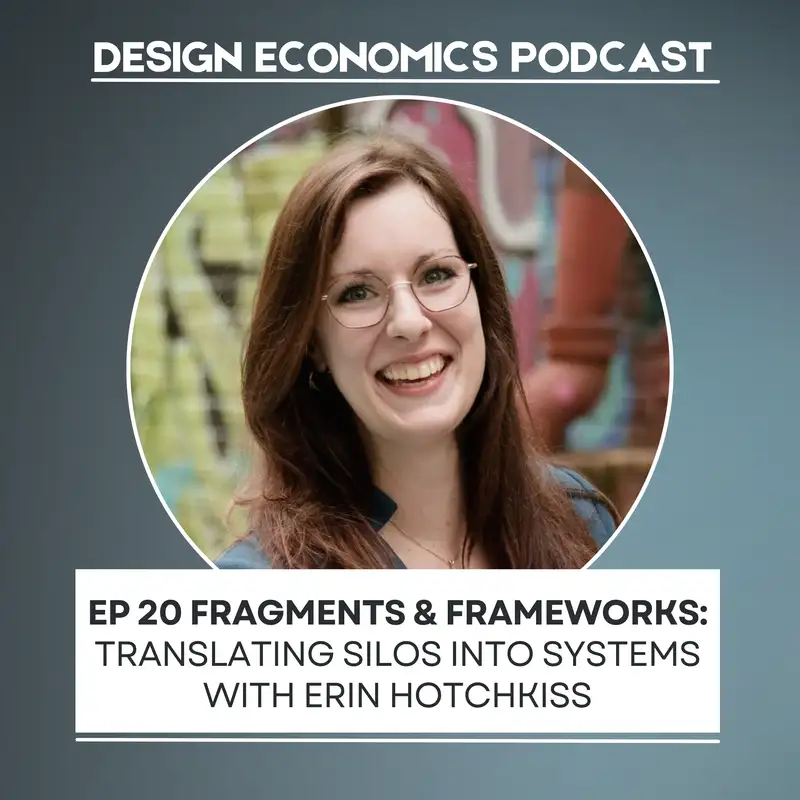
Erin Hotchkiss: Fragments & Frameworks; Translating Silos Into Systems
It is interesting that you brought up the healthcare piece and that was really in the back of my mind kind of broadening out of that but most of my career has kind of been spent there particularly in more rural areas and what I wish I knew from a marketing communication side was just how much economics, especially when you're talking about healthcare, really is an underpinning of choices. We just don't call it that, right? We call it all as a personal financial or right? Or they just don't have X, Y, and Z. But when we, in the healthcare space, you know, almost what is it 80%, know that your actual health is not based on the healthcare that you receive, but all these social and different factors compounding.
Erin Hotchkiss:And so I think to your point, seeing design economics just not across all the other causes and areas we've talked about, but also in the healthcare space, having some of that language be incredibly powerful and something I really had to study up on and learn in a retrospect. And now it's kind of that time to be proactive.
Vinny Tafuro:I'm Vinny Tafuro. This is the Design Economics Podcast. This is episode 20. It's a special episode today. I'm joined by the Institute for Economic Evolution board member, Hotchkiss.
Vinny Tafuro:Erin Hotchkiss joined the board this year after we met at a conference, last September. And we're gonna be doing a little bit of a different episode format today. The point of it is going to be going through some of the background of the institute and celebrating the ten year anniversary of the publication of my book, Unlocking the Labor Cage, and how that led to the formation of the institute. So I wanna welcome Erin to the podcast with me, and I'm looking forward to a dynamic conversation about a whole bunch of things in design economics, how things came to be, how Erin found us, and why she's here, and and what we're gonna be doing together as as part of the institute. So, Erin, thanks for being here.
Erin Hotchkiss:It is a delight to be here and fun to get flip the the mic on you when the host becomes the interviewee, so this will be great.
Vinny Tafuro:I'm super looking forward to it. It's been, like I said, 19 episodes. When I did the when I did the the the pilot episode in December 2024 with Paula and the fact that she is also one of our coalition members and she was an early person I talked to about it, it's nice to kind of come back to let's talk about the institute.
Erin Hotchkiss:Yeah. And even when I reflect on even this meeting you, which will talk about just the growth and folks you brought into the fold, so very much excited to dig a little bit deeper for folks listening.
Vinny Tafuro:Yeah. This is, you know, it's also I am recording this. We are on opposite sides of the planet. I am visiting my brother in Indonesia. He lives in Jakarta, and I had the opportunity to meet for coffee and breakfast a few days ago or a few weeks ago at this point when this gets released with Masami Sato from b one g one.
Vinny Tafuro:And so it was really great to meet one of the podcast guests from the other side of the planet in person, kinda get to know each other, talk about the coalition, talk about the institute, and then here we are at the end of that same week recording this episode. So, it's just, we're becoming a global thing, and it feels really wonderful.
Erin Hotchkiss:Yeah. A very kind of full circle moment, and just kind of the beginning of what comes next, and I think that just speaks to the power of shared values and working towards something bigger and better. So we'll have to get into it.
Vinny Tafuro:Yes. Absolutely.
Erin Hotchkiss:So we'll get into it. Now before we kind of talk about the institute, really wanna use this tenth anniversary as a jumping off point to to really understand, you know, what were you seeing at the time?
Vinny Tafuro:So to as a jumping off point, I and, you know, I'll jump back to the first book before that, which was Corporate Empathy, and it was the idea that, you know, when when somebody forms a small business or a small enterprise, you know, look at some of our podcast guests that are local businesses, they have the kind of moral compass and philosophy of the founder. And what I was exploring with that first book was like, why when a company gets to a certain size and scale does it have to become only money based, only, you know, efficiency over humanity? And that first book, it was called Corporate Empathy, and after publishing it, I found the organization Conscious Capitalism and got involved with that organization, saw the power of a brand knew the power of a brand, started the Conscious Capitalism Florida chapter with a few people here in Tampa in Tampa, Florida and around the state. Made it a statewide chapter, and it was really a way of talking about stakeholder stakeholder capitalism. And this conversation around how companies can do better while being profitable.
Vinny Tafuro:It was always about you still had to be profitable if you're gonna be a company. And it really allowed me to explore and learn what was going on in different places and in different organizations that were all working on this problem of how do we make companies and and the market do better than it is for people.
Erin Hotchkiss:I think that's an interesting point that you were observing of when it got to a certain size. Right? This trying to balance or bringing in that empathy and humanity just kinda seemed to go to the wayside and just how we define labor, like within just our our larger infrastructure is really interesting. Tell me a little bit more on the the conscious capitalism when you're really kind of going into the second book of unlocking the labor cage. It sounds like you're having this kind of convergence at the same time or quickly after with conscious capitalism in in Florida.
Erin Hotchkiss:So just would love to hear you talk a little bit more about that and what kind of gaps you were still seeing or observing.
Vinny Tafuro:Yeah. So the what was happening at the time is I was working on my undergraduate at the time because I've kinda taken that each each decade of my life, there's been another level that's been accomplished. And at that time, we were also doing conscious capitalism. And I was learning that, okay, there's what I was running into at that time was this idea that, well, if automation and globalization and this kind of disregard of of the humanity of people was happening, Well, what if we expand the definition of labor and what it meant to do work? And my idea in in writing that book was to well, if we expanded labor to include, you know, creativity, to include caretaking, to include all of the soft things that, you know, we do that fills our day and fills our lives, then that would provide enough work for everybody.
Vinny Tafuro:And when I talked to a labor economist at the time, because I was looking for some, like, insights to to put into the book, you know, I'm calling the book Unlocking the Labor Cage, What the Future of Labor Is, and I went to a labor economist completely innocently and said, hey. Would you help me with this? And, you know, deadpan answer, that's not my field of study. And I was just kind of flabbergasted. I'm like, you're a labor economist.
Vinny Tafuro:I'm talking about the future of labor, and you're saying this is not your field of study. And I I did not understand that at the time.
Erin Hotchkiss:Yeah. I also still kind of baffles my mind to to hear that even as you described, right, this idea of creativity and caretaking as or not soft, but, you know, being viewed in that way and then an economist saying that's not their purview. I mean, it's really interesting. That sounds like you were asking the right questions, but coming up, you know, it's these trying to figure out what is that kind of next right answer through the conversations you were having and just epiphanies that these softer, right, ideas of different models, you know, unique models of creativity and markets.
Vinny Tafuro:And that was like that was the thing is is I would I was asking I I believe that was asking the right question, and I I know now that I was asking the right question, but the the professionals that position themselves as the person that you would go to to probably answer that question literally had no interest in that question being answered. And it and and again, it was just like, why not? And so that's really in that period of putting out unlocking the labor cage and navigating conscious capitalism. We were doing workshops. We helped in the state of Florida, we helped pass b corp legislation, making b corps a possibility for entrepreneurs in the state of Florida.
Vinny Tafuro:And all this time, I'm bumping into this blind spot of, well, we just don't count everything, and that's just the way it is, and I don't like that answer.
Erin Hotchkiss:Yeah. The that's just the way that just the way it is is never kind of a good answer quo. I think that just speaks to your your futurism, and really kind of the the point of these two books and IEE Institute of Economic Evolution as well. So you're doing all these different workshops and passing b corp legislation and really convening different people, it sounds very still kind of fragmented at this point. Tell me a little bit more kind of where you went from there after kind of doing all of these different actual work, right, moving things forward, but still seeing this kind of fragmentation and not being okay with how it is.
Vinny Tafuro:Absolutely. That was you know, getting now so the book was published in 2016, and, you know, I did a book tour in New York, Boston, San Francisco. Anywhere I could take books with me in a suitcase or have them shipped, I brought books with me, put notes out there, you know, event invites, brought people around, took photos, you know, did the whole thing. And that led to a few events in 2017. I was invited through a friend of mine had a former professor at the University of Washington, and he was organizing a workshop in Ziegen, Germany at the University of Ziegen.
Vinny Tafuro:And it happened that the week before that was going to happen, there was also a conference in Edinburgh, Scotland, and that was being held by the Institute for New Economic Thinking. And I was like, oh my god. Institute for New Economic Thinking. This has to be the place that I'm gonna get these questions answered, and I'll be able to go right from that into this workshop in Uni Zeegan, and we're gonna we're gonna fix the problems that that I'm I'm asking questions about.
Erin Hotchkiss:I also, it's so interesting, right, as you're talking about the places you were learning and taking these questions, you know, internationally outside of, you know, our country to bring that back, and how do we think about these different principles and building in a way, you know, from where we just sit in our own kind of economic model. I think it's also really interesting. How did that feel? Like, you're taking these books, you know, you're traveling around, you're asking questions and getting, you know, maybe hitting walls and then kind of finding this group and kind of having, okay, like, did that feel?
Vinny Tafuro:You know, from a personal, like, standpoint, it was, you know, I got to go to Edinburgh and, you know, the the nerd in me in as an entrepreneur and now as an economist. So, you know, I I I had extra time the first day I arrived, and I took a side trip to see the birthplace of Andrew Carnegie. I mean, like, that that was my, like, what's on your trip to do when you go to Scotland for a week? It's like, well, let me go visit the birthplace of Andrew Carnegie. Then, you know, one of yeah.
Vinny Tafuro:My days that I And then, like, one of the the next day or the middle of the day that I was there, you know, of course, I was staying at with a couch surfing host. And he lived on the Royal he lived on the Royal Mile, and literally like a 100 yards from Adam Smith's gravesite. And so, you know, I had breakfast one morning and walked to see Adam Smith's grave. Like, that was the personal experience of me traveling to Edinburgh.
Erin Hotchkiss:I I think that one speaks to we all have a little bit of nerd in us, but like the things that we grasp on and how important, right, those kind of origins and foundations of, you know, where do we start and where are we going? That's why I love that for you. So I'm curious when you came back from, you know, Edinburgh Edinburgh and kind of looking at this experience that you had walking right to Adam Smith's grave, you know, and having your your coffee. What did you have a kind of a realization coming back from that about just how traditional or mainstream economics is really functioning?
Vinny Tafuro:Yes. And that's you know, the the conference itself was my first really academic economic conference. And it's also the first place, you know and the thing is is so INET was founded by George Soros. After the financial crisis, he dumped in, like, $50,000,000 or something like some ridiculous amount of money to create this institute to come up with new economic thinking. And the conference was all academics.
Vinny Tafuro:It was all really discussions of here's my paper on the economy within the confines of current economic thinking, but somewhat new. And the new part for that conference was INET was a very left of center or liberal or demand side conference. And so all of the new economic thinking was based on how do we improve social safety nets and government intervention to fix the problems that economics at that point, I was starting to realize economics refused to see and count.
Erin Hotchkiss:I think that's an interesting word that you say, refused to see and count. Expand on that one.
Vinny Tafuro:So and that's, know, what you know, here again, I had, you know, very kind of progressive in mindset, but it's also the same conference. It was the first time I heard the term mannel. And a mannel is a panel of all men talking about their papers. This was mentioned and highlighted at the luncheon, which was the only panel that was all women.
Erin Hotchkiss:There's also an interesting irony irony in there.
Vinny Tafuro:You're saying And so
Erin Hotchkiss:For this refusal, so you're like, okay. What's happening with this kind of dichotomy here?
Vinny Tafuro:Yeah. And there were a couple times, like, there I forget, know, it's a long time ago now. There was one one of the sessions that I asked a question, and just the answer was no. Like, it was like it was it was not a, oh, that's a curious question. It was just no.
Vinny Tafuro:Like, I don't you know, that kind of response. Again, it was nine years ago. Don't remember what the question was or the session was, but I just remember coming away from going, this did not answer any questions, and it's not going to offer any answers.
Erin Hotchkiss:And I think that's challenging too when you think about trying to, right, challenge and just look at different paradigms differently and just asking those questions. So that straight no is really difficult. I also think the the mantle, which I'm still cracking up about. I don't know if there's a female panel. I think that goes back to what you mentioned earlier, this idea when you went to the labor economist, he was like, oh, caretaking.
Erin Hotchkiss:That's just that's not in there. It's too kinda soft. And as you go through these different experiences, you're con through conscious capitalism, you're seeing these gaps, you're having these kind of no's and this realization of, okay, these soft things from the view of traditionalist doesn't have to be soft. And in fact, it seems like a very key piece right of our kind of economic model and recognition that's missing. Tell me a little bit about where you see like, is that a bridge, do you think?
Erin Hotchkiss:Like, where do we kind of go from there?
Vinny Tafuro:Well, and then, you know, so the following week, when I I ended up at the Uni Zeegan workshop, this was only 40 people. It wasn't a presentation of papers. It really was kind of a two day hosted at this campus discussions on different things. So we broke into groups and tried to problem solve, and looking back at it now, there was a lot of so this was the first place that I heard the word heterodox. And remember, at twenty seventeen, you know, I had an undergraduate degree.
Vinny Tafuro:I was not well versed in academia. And so I learned for the first time that heterodox is outside of the orthodox. So orthodox is mainstream. Heterodox is outside of the mainstream. And, you know, so UNI Zieggen had a heterodox economic program.
Vinny Tafuro:And the gentleman, the colleague that Lance Bennett from University of Washington that had invited me, He was part of a heterodox economic program at the University of Washington. You know, if you kind of go to today, if you were to look at like donut economics or different things like that, Kate Rayworthsburg, those are heterodox. They're not in the mainstream. And so that that was a new term for me and a new kind of understanding. Like, okay.
Vinny Tafuro:So there were 40 people in a workshop, and there were a dozen new outside of the mainstream ideas, but none of them were talking the same language.
Erin Hotchkiss:Having even that shared language. Right? I think it's so what a larger insight that there was a need to have a program, right, called heterodoxy. Like, having to call that out, I think that speaks to a little bit of what we'll get into some of the design or when we think about design thinking and how that works in the context of economics. But I think that is really, really interesting that there needed to be it's kind of outside the recognition of a program, then you get in it and there's still this kind of gap, right, in a shared lexicon.
Erin Hotchkiss:Where did you kind of where did you knowing that there's this gap in a lexicon, you're in this program, you're learning these different things, getting introduced to new kind of concepts and words, you're still seeing this gap. Right? Like, you still have this itch that sounds like you're trying to kind of scratch as you're Yes. Moving forward. Yeah.
Erin Hotchkiss:Was like, you know, tell me a little bit more. Like, okay. Like, there's still this lack of language even though you're seeing this larger need and hunger for different people, right, to come together and look at, you know, untraditional heterodoxy models.
Vinny Tafuro:Yeah. And so, you know, I kept exploring because I'm like, okay. The answer has to be out there. Like like, I'm I'm way like, it can't like, there's gotta be an answer. And so, you know, that was November 2017.
Vinny Tafuro:And so six months later, I had the opportunity to attend the FIE conference. And FIE is the foundation for economic or the foundation for economic education. And fie.org has been around since the late forties. They are a libertarian right of center organization. Most famously, they were a large funder for Milton Friedman, the kind of head of the Chicago School of Economics, the economist that that really was the name and person that that was cemented as the kind of shepherd of libertarian supply side economics that, you know, the free market will solve the problems.
Vinny Tafuro:And so I attended that in June 2018. And walking around that, I'm like, okay. This is the libertarian conference. This is the, you know, we're we're gonna solve the problem with with this answer. And I found the same problem is on that side, the market, Adam Smith's market economics, there was an invisible hand.
Vinny Tafuro:And the invisible hand would magically take care of anything economics didn't see the need to count and take care of. So that's where I really solidified. If you're on the demand side, the left side of economics, then the things you don't wanna handle as an economist get handled by the government. And if you're on the supply side or right libertarian market side economics, the things you don't wanna count are the invisible hand that the market will magically take care of. Both of them refused to count these softer things that were invisible to current metrics.
Erin Hotchkiss:Huge gap, right, of that kind of in between. It sounds like you're getting closer to that diagnosis really of that kind of problem of, okay, if we see this on both sides of the aisle and there's this refusal, and in some ways, maybe purposely built in that way or not my problem right on the left on the demand side or the supply side. How would you diagnose that problem of addressing that gap and lack of recognition and counting of that kind of softer middle piece here?
Vinny Tafuro:So and that's really at the same time in in kind of that that period, I had applied to give a TED Talk. Or I applied to give about 11 TED Talks, and one of them called me back. At the same time that that was coming together, the subject of the TED Talk ended up being this idea of counting social capital as part of economics. That we can count financial capital, it's very important, but social capital is as important. That is the social fabric that brings people together, that that if we don't have social capital, we can't trust financial capital.
Vinny Tafuro:And that's what the subject of the TED talk ended up being that came out in June 2018. It's also what the basis of the institute became. And at that TED Talk, that was where I announced the institute. I registered the domain name before the TED Talk was released. That's when, like, I I you know, we formed our first board under a fiscal sponsorship of somebody else, and so that was kind of that genesis moment.
Vinny Tafuro:I had done enough exploration in in my belief at that time, and and I still believe it now, that there was no current organization doing this, and so I wasn't I was filling a niche that was genuinely there.
Erin Hotchkiss:Filling a niche that was genuinely there. I think the there's always the quality over quantity, I think, in these heterodoxy ways of thinking. But what you had just shared, right, of if we don't have that social capital and fostering that and giving that just as much priority, then that financial capital, right, is not going to work. And I think even when we right. Let's just wave our hands around.
Erin Hotchkiss:In this economy, I think we're seeing those symptoms and why, right, not only just from you founding the Institute of Economic Evolution, but the people that have wanted to come in the fold and really participate, whether that's just on the coalition side or podcast guests that we've had previously. And it just speaks to, right, this recognition of we need to do better, and there's an opportunity to lift up the importance and recognition of social social capitalism really to make the rest of our economy work. So tell me why in a little bit, and this is maybe a softball. Why is this design economics? Share a little bit more about that.
Vinny Tafuro:Absolutely. You know, so there was after the TED Talk was released, you know, there wasn't a lot of movement in the beginning. It really was kinda like, okay, what do we do with this? Like, you know, the the opportunity was there, the void was there, but how to how to really fill it wasn't. How to structure it.
Vinny Tafuro:Because you could talk about social capital, but everybody defines social capital a different way. That that that was what I started running into. And, you know, our board, we we were a small board and trying to figure out, you know, where to go with it, how to how to talk about it. And then COVID happened. And, you know, shut down, obviously.
Vinny Tafuro:And what ended up happening with the institute is we took that opportunity to, in the first six months of COVID, to start the organizational process of becoming our own five zero one c three. We're like, okay. We're not raising money right now. We don't have a well defined dry like, framework, and everybody else is competing. Like, there's so many other needs that were immediate in that period of time that raising money for this just wasn't going to happen, and we didn't have a clear direction yet.
Vinny Tafuro:At the same time, I had a colleague that was attending the University of Houston's foresight program for their graduate certificate. And I had been previously introduced by a board member to the director of the foresight program at the University of Houston. And I was looking for a graduate program because at this point, was learning. I was like, I need to be able to talk the language of academia and be able to translate it to my friends and colleagues in the market and in the social sector. And so I was like, okay.
Vinny Tafuro:And the foresight program at Houston was the perfect tool for that. Because I had looked at economics programs, and any master's program in economics, I would have to unlearn everything I was trying to bring to the world. If I looked at other programs, like, looked like communication programs, but I would have to bend the tool too far for it to fit. Whereas the foresight program, I ended up in the first couple weeks of the first semester, I had described it to my board members as this is a graduate degree in getting stuff out of my head in a way other people will understand.
Erin Hotchkiss:That's the great definition. That's the great headline. And I think that speaks to, like, you're such of a blend, right, of you weren't you said you weren't academic yet. I don't you know, this kind of, like, interesting piece, but it's so important. And I think what you're describing is, okay.
Erin Hotchkiss:How do we have the shared language that was such a gap that you were seeing? But then being able to translate this theory really into action, right, and designing that around the different context that's showing up. So I think that's a, one, a great pitch to a bore, but with the way that you you think, I think being able to translate that is just everything. Right? We can't sit in our ivory towers.
Erin Hotchkiss:If we also don't have some of the shared language and deep kind of theory and research as a foundation, an operating system, if you will, when we think about an application, we might be just be kind of flying blind. So I think that's a really interesting kinda intersection to be living on, and really what the institute right is doing as well.
Vinny Tafuro:Yeah. And as I was proceeding through my graduate program, I had actually I'd had a a lunch date with somebody, and they were in a different realm of science and, you know, a new concept, Thomas Kuhn's theory of scientific paradigm change. And this idea that, you know, paradigms, whether it's biosciences, earth sciences, medicine, know, the theory of you know, there was a theory once that fire was actually inside flammable objects, and that was the dominant paradigm until in, like, 1777, scientists uncovered that it was actually oxygen that burned. It wasn't fire being released. And so I was like and what it was was as soon as the new thing was easy to understand, it replaced the false thing that preceded it.
Vinny Tafuro:And this is the this is Thomas Kuhn's cycle of of change in in scientific paradigms. And so I looked at, you know, this idea of, okay, what if we break economics down to first principles? And this was kind of that genesis moment for design economics, is the fact that, alright, the first thing we need to acknowledge as an economist is that paradigms constantly change. If you cannot acknowledge that paradigms change, then you cannot be an economist. The second part of that is if you're going to adapt to changing paradigms, you need to be creative.
Vinny Tafuro:And the way economics currently is set up, it punishes creativity. If you ask a question outside the mainstream, I e, what if we expand the definition of labor, and the answer is you cannot, well, you're not, You're punishing creativity. You're not acknowledging or embracing it. And then the third is like the oxygen theory. If you don't make your new paradigm understandable, then it can't displace the previous paradigm.
Vinny Tafuro:And so those three realities are what coalesced as design economics and really became the three tenets that we that we have as the design economics tenets.
Erin Hotchkiss:And I can only imagine sometimes bringing the word creative right to those traditional economists just the, oh, well, creative. That's all. But I think creative is sometimes misunderstood, particularly when we're talking about in this kind of field. So I really appreciate how you've brought that actual word into the tenets, and the design economics.
Vinny Tafuro:Thank you.
Erin Hotchkiss:If you yeah. So seeing these three kind of principles, right, acknowledging that paradigm of change and of bringing creativity, embracing that, what did that lead to from the 10 you know, these tenets that we have forward in the institute?
Vinny Tafuro:So it it came down to the one defining piece that was put together was I put out my first academic published article in 2023, and it was a it was basically a call for creating a field or a discipline of design economics and solidifying three tenets that qualified an idea or theory or a metric for belonging under the umbrella of design economics or design thinking in economics. And so the three tenets became acknowledging paradigm change, embracing creativity, and embracing economic literacy to make sure people could understand economics instead of throwing their hands up and going, this is economics. I can't handle that. From there and this was where kind of the blending of, you know, the graduate program at Houston, Houston Foresight uses what's called the Foresight Framework. And so it's this kind of, you know, conical, you know, historical context, and then, like, there's the contemporary, like, lens of of where you are today, and then there's this conical shape out to the future.
Vinny Tafuro:And so I modified that diagram to be a design economics framework, and that's kind of more my own work on that. And what what it ended up doing in that piece is my own framework fits the tenants of design economics. And that's so so for a period of time there
Erin Hotchkiss:Yeah. Almost a pressure test against yourself in in in some way. It's like that intellectual honesty.
Vinny Tafuro:Exactly. But what that ended up doing is it may it it it was a blending. So then design economics and the design economics framework became one of the same thing. And that was the challenge posed to me by the board in early twenty four was, okay. If this is gonna be a nonprofit, if, you know, we had we had been a five we we were a five zero one c three in 2021.
Vinny Tafuro:But if we're going to be a charitable organization, we're going to be a think tank, we're going to raise money and work on bringing these initiatives to the world, then we need to separate Vinny's Design Economics Framework from the institute's design economics tenets. And so we did a lot of work to re to change and and evolve the messaging that the institute put out there to separate those two things. And then that led at the end of twenty twenty four to creating the Design Economics Podcast. And the purpose of the podcast was to bring on different voices from the social sector, from the academic sector, from the life sciences sector, from the market, and each of those that fit the three tenets. And that's why when you go back through the last 19 episodes, all of those episodes bring our guests and the work they're doing through those three tenets.
Vinny Tafuro:And that's really the key piece then is now we've spent the last two and a half years showing how all of these different thinkers, all of these different ideas, all check the three boxes of design economics thinking's tenets.
Erin Hotchkiss:I also think the folks we've brought on the podcast doing this work really across different types of sectors, causes, right, just kind of models of infrastructure and also speaking to regardless of that, these tenants are really that grounding point and working all these you know, we can work towards something larger while also, right, designing for that kind of specific, right, environment or organization, you know, we've spoken with them. So I think that's also really just interesting. Again, the applicability of the tenants while also understanding the nuance and bringing that in to, you know, kind of that whatever insert organization enterprise cause here.
Vinny Tafuro:Yeah. And, you know, and that's the thing. So one of one of the early guests, Eric Eisenberg, is a colleague and friend at the University of South Florida. And he had when we first met, or and we're talking about this stuff before he was on the show, he has a book called Don't Waste Words. And it was the first like, one one of the things in in in the book was, you know, if I'm gonna throw a ball to you, I'm going to look, make eye contact, and make sure that I think that I believe you're gonna catch that ball.
Vinny Tafuro:Whereas when we communicate with people, we often throw words out to people and disregard whether or not they actually catch those words. And so it was really a cool kind of, like, real world analogy for how so many different organizations, different disciplines, they will talk to each other or talk at each other. Again, this is kind of what I saw in Zeegan and I saw in Edinburgh and Atlanta, Georgia with the conferences, was everybody was interested in telling their story or their idea. They didn't really worry about whether or not anybody caught it. And the idea of somebody in academia being having their language caught by somebody in the market or something.
Vinny Tafuro:There just wasn't. Again, we were coming down to there's there's a missing language for people across different disciplines and sectors to talk to each other.
Erin Hotchkiss:And that really with Design Economics and even the tenants that you just shared is really kind of that ultimate goal, right, of bringing that literacy. You know? I think that's what drew me because you said, you know, you people throw their hands up and say, oh, economics is too hard. And I had that own false narrative for myself right until getting to meet you and really understanding, okay, this doesn't have to be as complicated and in fact, maybe it's been convoluted on purpose, right, to keep some of us Joes and Janes, if you will, kind of out of the out of the folds. I think it's really interesting of that kind of echo chamber, and That can happen, right, whether it's in the market or the academics, but really to make any kind of progress and change a paradigm, that shared lexicon is is key.
Vinny Tafuro:Yeah. And and, you know, it's one of those one of those things. You go to the visual the the economic literacy part ten and three. And, you know, I often make this, you know, talk about this, that, you know, if you ask somebody and on the spectrum from, you know, highly educated to, you know, somebody that's, you know, technical skill educated, if you ask them about a geopolitical situation, or you ask them about a, in The US, a Supreme Court ruling, they will give you their opinion full force and without hesitation. If you ask them a question about economics, even the most educated academic that is outside of that field will qualify their answer and say, I'm not an economist, but because economics has purposely made it more complex, because they've had to hide the the fact that they're not counting all of these really important things.
Vinny Tafuro:And so we qualify and say, I'm not an economist, but here's my belief. Because in economics, you're only supposed to choose one of two teams. You choose supply side or you choose demand side. Those are your choices as a layperson, and I just don't believe that's right, and I don't believe we're gonna solve problems that way.
Erin Hotchkiss:There's always a third option in my opinion, and much more than that. But when two is presented, there's always another way. So thinking about speaking of another way, you're really kind of building the structure out with the board. And the board gave you this challenge, right, of how do we bring people in the and have that shared language, kind of getting into that next level kind of growth and maturity as the kind of a think tank. The board really gave you this challenge, right, to go out and bring people in the fold in the shared lexicon.
Erin Hotchkiss:Thinking where we're sitting at now with the design economics, right, and then institute economic evolution as a think tank, where are we at?
Vinny Tafuro:So where are we at? We're we're now a year and a half and 20 episodes into the podcast. We've increased the podcast now to a three week cadence, and which is really great because with this kind of topic, the the episodes are pretty evergreen, and going to every other week would be a machine that feeds the algorithm, and I don't wanna be part of that. Every month or five weeks, we could only get 12 episodes a year out. And so I'm enjoying this three week cadence of getting, you know, like 18 episodes a year out.
Vinny Tafuro:I think the conversations flow really well. There's not a not a big gap. The other part is having the podcast has allowed us to build the coalition. And so the coalition is focused on bringing together academics, thought leaders, social sector leaders, and business leaders, and giving them the language to talk amongst each other and talk in between each other, or in between those disciplines. We've got interdisciplinary conversations happening.
Vinny Tafuro:One of the first things we're gonna be doing right now, that's gonna be produced by the coalition, we've got kind of two things that are coalescing. Number one is I'm working with six other colleagues. All of them will end up being part of the coalition when this gets published, but we're gonna be working on second paper. The first article that came out in 2023 was all my voice, and it was in one journal, the journal of World Futures. This next article is going to be focused on here are the tenants of design economics, and so I'll lay out that part of the conversation.
Vinny Tafuro:And then after that, the rest of the article will be my colleagues talking about economics in their field and how to use design economics in their field. So Eric Eisenberg will be part of it, and he'll be using design economics tenants to link to communications. Walter Balzer, another guest, previous guest and coalition member. He'll be using the tenants to talk about distributed education systems. Paula Seymour from Flagler College.
Vinny Tafuro:She'll be using the tenants to talk about social enterprise and and the different aspects of entrepreneurship. So we'll have this article that then, what it will do with the resulting thing from this will be the fact that right now in academia, in the documentary systems of the world, basically what happens is everybody's talking about late stage capitalism or exploitative capitalism or this kind of capital or the end of capitalism or or capitalism that, capitalism that, or just we're burning down the world. There is no, there's no like, okay, what comes next? I'm tired of the dystopia. And so what this article should do on the academic side is if you're properly researching before you publish something, you should be able to discover this article and go, oh, wait a second.
Vinny Tafuro:I'm in the education sector, there's language for me to use. I'm in the social entrepreneurship sector, there's language for me to use. I'm in the communications sector, there's language for me to use. So that's gonna be the point of this article and the coalition for that piece.
Erin Hotchkiss:What a thrill one. You know, I and many probably listening are very much looking forward to reading this article, but what a thrill I think of of live proof. And I'm sure that well, how did I mean, just that feeling right of seeing that and really taking that to the next level, but I also like how you said tired of the dystopia. If we have to have so many descriptors or adjectives in front of capitalism, then maybe the system's not working and there's a different way. So just very exciting that you've got, you know, six of your different colleagues coming into the fold and showing how this can work in so many different contexts.
Erin Hotchkiss:Most importantly, having all that shared language. I think, again, just just that kind of proof of concept, if you will.
Vinny Tafuro:Yeah. I'm really excited about it. I've, you know, it's I've often said with this, because I'm like, well, what's your in with this? Or what I would love some of the ideas that I have for how the nuance of how things could function better would get implemented. That would be amazing.
Vinny Tafuro:However, the purpose of the institute, the purpose of really doing this is I just want, at the end, for everybody who's working on these problems to have a better ruler and a better dictionary to approach the problems with, one that people can share more easily and and talk interdisciplinarily together.
Erin Hotchkiss:I think that's also the power of the coalition that we've been building and creating that kind of mind share right in a space to be able to have some of these discussions with that shared language. I wanna hear a little bit more about the the coalition. We've touched on it, you know, kind of where it started, but really in this next evolution of the Institute of Economic Evolution, where where we see that going, and kind of some of our our goals to bring, right, these different thought leaders into the mix of this kind of greater mindshare.
Vinny Tafuro:Absolutely. The you know, so and I think this is a good transition coming up here. It's allowed and so some of the recent guests, you know, like, I met Mirin through the same b corp conference and organizers, Jared Myers, who organized the BLD b corp conference. He introduced you know, it was through that that I met Nathan, who was one of our guests and part of BLD Southeast. It's how I met Mirin Oka and, you know, talked about employee ownership and the employee trust.
Vinny Tafuro:It's how, you know, Mirin introduced me to Masami Sato with b one g one, who's also a b corp at a you know, in in Singapore. Yeah. So the power of the network there, you know, same thing on the academic side. It was, you know, Eric Eisenberg is the one that introduced me to two of our other guests, Paula and Stan. So we understand the power of networks.
Vinny Tafuro:And so what the coalition is going to do is really start bringing this together. And now we're at a point with with this that we can start doing more work. We've got more of a working board. And I think, you know, again, this is a good part to introduce you again. And the fact that, you know, in attending the b corp conference, you and I got to meet.
Vinny Tafuro:And through that network, you know, so many other guests and people that are gonna be that are part of the coalition, or we're talking about how do we how do we do something. So, like, we have this idea for the academic article, but now, Mirin and Masami and I are talking about, okay, How do we engage the business community in the coalition to come up with something for them to do? And we'll do the same thing with the social sector. And this is where, you know, you and I are now working together. And, you know, you're part of that cultivation aspect of the institute.
Vinny Tafuro:And so I really kinda wanna get into now what you saw because I think that's the best way to kinda go forward from here is for me to stop talking a little bit and for you to tell us, okay. What what landed you know, how how how did you come to meet me and and learn about this and and how it resonated?
Erin Hotchkiss:Well, you can take back the host, Mike. That is fair. Well, you know, I I I'm sure you're probably like, who is this woman? So to your point, we got to meet. I was in a really interesting transitionary point in my career having worked in some pretty high paced corporate environments and also being part of this very human based sector where empathy is which was important is kinda driving that that bottom line.
Erin Hotchkiss:And at the time, that's when I went to the b lab b corp conference down in the fall. You were, I think, speaking on a a panel. It was three people about strategic partnerships. Nothing really about design economics. It just dropped the language of design thinking.
Erin Hotchkiss:I was familiar with that and used that in my work on being in a brand meets social impact programs and communication. I was like, I know what design thinking is. How the heck does that work in an economic standpoint? And don't even know what economics really is. So it just was you were so open.
Erin Hotchkiss:I said, hey, tell me more. And that's really kind of where we are sitting now. So I think it speaks to the the curiosity, but also just openness. And that's what you know, now we're sitting here, and I'm just honored to be able to be part of the the board and of, you know, building that on the business side because I think sometimes it feels kind of like a wall between those academics and the business. And I also am a nerd and looking to continue kind of building that academic side to be able to bring it into business because I've seen that power when you can have that shared language and get people thinking differently, but that just becomes so many of the barriers in my own personal work.
Erin Hotchkiss:So I was like, ugh. This might be that solve that I've been really been looking for.
Vinny Tafuro:I appreciate that. And and it really was, you know, when we talked, I think it was in the break or or something, you know, when we first got to talking. And, you know, I I looked at you as, you know, you're the social impact strategy, you know, that understood how to blend the conversation between market and purpose. You also your your health care experience. And I think also oh, we because, you know, we talked a little bit too because, you know, about the kind of, you know, rural communities and how that how economics is missing, you know, that part of of how the social capital or social infrastructure of the country and different different communities work together.
Vinny Tafuro:So it's all of those things that I was like, oh, this person, I need to talk to them more. So I'm glad we both kinda looked at each other like that because you really were somebody that I saw immediately understood the design thinking aspect of bringing design thinking into the economic conversation, and it just really fit really well. And so I was glad we were able to nurture that first conversation.
Erin Hotchkiss:Yeah. I am as well, and I appreciate that. And I think when people have that shared purpose or values or really that big picture end goal, things just feel natural. And it's interesting that you brought up the health care piece, and that was really in the back of my mind. Kind of broadening out of that, but most of my career has kind of been spent there, particularly in more, you know, rural areas.
Erin Hotchkiss:And what I wish I knew from a marketing communication side was just how much economics, especially when you're talking about health care, really is the underpinning of choices. We just don't call it that. Right? We call it all as a personal financial or right or they just don't have x y and z, but when we in the health care space, you know, almost what is that? 80% of that your actual health is not based on the healthcare that you receive, but all these right social and different factors, right, compounding.
Erin Hotchkiss:And so I think to your point, seeing design economics just not across all the other causes and areas we've talked about, but also in the healthcare space, having some of that language be incredibly powerful and something I really had to study up on and learn in a retrospect, and now it's kind of that time to be proactive.
Vinny Tafuro:For sure. I mean, is there's so much fragmentation, and, you know, it's I I I really believe, like, solving, you know, the the health care issue, you know, issues, working on on caretaking, these are the soft or or non these are the, you know, things that just the the market doesn't function if you don't have a healthy, engaged population, or it doesn't function in a way that I think most people would want to live in. And I really believe that, like, this idea that that, you know, design design thinking is kind of the academic or the professional term for it, but it you know, I look at it as holistic or complete thinking, you know, in the fact that we have this data. You know? I I go back to often the the invisible hand of the market.
Vinny Tafuro:I think if Adam Smith were to have popped out of that grave when I was in Edinburgh, he'd say, we have data now. It's called social capital. I'm sorry you still think it's invisible.
Erin Hotchkiss:Oh, if only if only Adam Smith. Well, maybe someday in a in a different maybe university will be able to have a conversation with Adam Smith and ask him some of those. I also think, you know, I'm a kind of systems thinker and I didn't. Now I have that language when I found some of that practice, but this really kind of takes that and goes a step beyond when I think about designing the communities that we're we're actually serving. And I always joked, which I think was more telling, was to get into the health care system to understand the system and then get outside of it.
Erin Hotchkiss:And it really feels like getting to meet you and being able to join the board is really this kind of kind of moment, a culminative moment to what's ahead next.
Vinny Tafuro:Yeah. I I I agree and I appreciate that. And I think, you know, it's it's funny because I had looked at that. It's like, do you change a system from within, or do you replace it by creating a better system? And, you know, whether it's, you know, in my in my article and and over time, like, I you know, right now, there are more heterodox, non mainstream economic thinkers and ideas that have real problems.
Vinny Tafuro:They outnumber the mainstream. What they're lacking is a shared lexicon, a shared language, a shared understanding that they're all using they're all working on the same problem, and they don't have the the the tools to talk about it the same way. And I'm I'm hoping, you know, we as, you know, the the design economics at the institute, we can come together as a coalition of of thought leaders, academics, business leaders, and social sector leaders to go, hey. We have this way of talking to each other that can solve really big audacious problems that currently are unsolvable because they're not gonna be solvable from within one silo.
Erin Hotchkiss:And then I think as we're reflecting on the the future, I wish I could give you a magic wand and maybe even Adam Smith to wave a magic wand. Because If they're having so many hetero docs, right, ideas, they're almost starting to outnumber in the mainstream to your point of earlier of the, right, the replacement, you know, paradigm replacement example. I think that's exactly this kind of precipice that we're sitting at. I But would like us to kinda think about the future as we're sitting at this state. I'm gonna give you a magic wand.
Erin Hotchkiss:If you wave magic wand, how would you change how, you know, people just think and behave in economics today. And you could take that from any kind of audience angle, but you could just wave the magic wand and that happens maybe not tomorrow in six months and a year from now. How would you
Vinny Tafuro:change that? I love the question. I I really with that wand, if I had one string to pull, and and I don't believe people understand the latent power of academia. Know, Kate Raworth in her TED Talk talks about, you know, everybody takes economics one zero one, and they hate it. They might pass it.
Vinny Tafuro:And whether you're in journalism, you're in biosciences, or you're in healthcare, you have this horrid memory of economics one zero one, and this simple simple answer to how the world works, and it's completely wrong. So if I had one And that's the thing is, later on in your career, you're a journalist, you still have this picture in the back of your mind of how the economy functions, and so that's why a journalist with decades of experience will say, I'm not an economist, but I'm like, no, that's not the right answer. And so if I had anything to do with it, it would be in academia. It wouldn't be political. It wouldn't be in the market.
Vinny Tafuro:It wouldn't be in the social sector. It would be in the academic sector, and it would be putting every economics department that doesn't understand the holistic nature of the economy being part of society that their academic accreditation would be on a six month warning. Like, sorry. You don't bring yourself yeah. If you don't bring your program into modernity and count everything, if you are still saying there's an invisible hand six months from now, you're no longer accredited.
Vinny Tafuro:If you're still saying, I don't wanna count time used in the home to care take care take care of children, I just want a social safety net, you don't have an accredited program. I really believe that would be the string I would pull is because all of these economics department like, I look at Kate Rayworth at the University of at Oxford University. She's not in the economics department. She's the renegade economist. She's well known by so many heterodox outside of the norm thinkers, but the economics department at Oxford is still the economics department of Oxford.
Vinny Tafuro:And I don't think that should be possible. It'd be like, Oxford allow the fire theory that we talked about earlier to still be practiced even though the science department has disproven it? Like, no. That's not reality. So that's my want.
Erin Hotchkiss:I man, that is one powerful want, and I think speaks to some urgency really of some of this kind of different thinking. I'm gonna give you I'm gonna give you another magic wand, but this one has to take a longer view. In ten years, if you had this magic wand that could see into the future, maybe I'll give you a crystal ball, Vinny. We had a magic wand. Now I'm gonna give you a crystal ball.
Erin Hotchkiss:In ten years from now, you're looking into this crystal ball about the Institute of Economic Evolution, you know, and design economics. Like, what would the crystal ball be saying? Like, if it had, like, a headline or I shook it like one of those, you know, magic eight balls. What would I be reading about the Institute of Economic Evolution in ten years?
Vinny Tafuro:The crystal ball. We we love this in foresight because everybody thinks we have a crystal ball. And in reality and in reality, the way foresight works as a as a as a discipline and a structure for guiding things is there's all of the potential or all the possible futures out there are the widest angle. And then from there, you have your possible futures, and then you have your probable futures. And then you narrow down from that, and you have your preferred future.
Vinny Tafuro:So what you're asking me with my crystal ball is what my preferred future is because we would need years to talk about all of the potentials out there. But no, from my preferred future, what I see, what we've done with the institute in ten years' time, we're now in 2036, is the just there's just no acceptance for an economics that doesn't count social and environmental capital as the inherently valuable foundation that financial capital relies on. The fact that that that is it.
Erin Hotchkiss:Well, appreciate you talking about your preferred future, a true kind of foresight and a futurist mini scenarios and possibilities. I think your answer speaks to really the quote you had on unlocking the labor cage that no law can change how human beings evaluate, like, this creation of value in society and only culture can. I think we use the word culture. Right? It's kinda everything we've been talking about, this different kind of shared mindset regardless of what side that you're on.
Erin Hotchkiss:So creating that inherent value of these softer things, right, of that social kinda capital is everything.
Vinny Tafuro:Yeah. You know? And I think that came from that that actually involved so there's there's, I think, somebody one of the founders of the Motley Fool investor site, and I think I met him at a conscious capitalism conference back in, like, 2013, and was talking about there there's a quote out there that culture eats strategy for breakfast. That you can have every strategy out there, but if the culture doesn't accept your strategy, your strategy is not gonna succeed. And same thing with this, is the economics departments out there and and the way we're thinking today is not going to tap.
Vinny Tafuro:Culture right now is breaking down. It's burning down. Everybody is looking for an answer that has a positive optimistic outlook on the world, but is still cemented in reality. And I believe we can get there. And I believe the culture will push the the new orthodoxy or the new paradigm to emerge, and hopefully, that paradigm will acknowledge its flaws a little bit more readily than the previous paradigm did.
Vinny Tafuro:Again, that might be I think another economist quote is John Maynard Keynes. It said, everybody is the slave of some defunct economist from the past. And so, you know, going out a hundred years' time, some other institute might be out there and pointing out the flaws that the institute today did not see. But I believe we are gonna help shepherd in a new paradigm.
Erin Hotchkiss:Absolutely. Progress, you know, it's slow, but sure, and think that's the the work we're doing here. Love that that culture will eat strategy for for breakfast, and even just from a brand wise too, same thing on the strategy front. If you're not building, right, for the people that you are serving, and we can put this in economics, it's designing, right, these models for the people that actually are living here, right, then it goes to the wayside and don't eat it.
Vinny Tafuro:Yeah. So I guess, you know, and and so I guess from there, I guess we should probably, you know, now that now that now as cohosts, you and I are pairing up really on the cultivation aspect of the institute. Cultivating new research, cultivating new ways of getting the economic literacy out there, cultivating new ways of supporting the work and research, and really, how do we get people to engage with the organization?
Erin Hotchkiss:I think there's a number of ways, kind of regardless of where you sit or where you feel your literacy level is at. You can go through the different podcast episodes, and with our different guests. A lot of, I think, something there for everybody, depending again where you kind of sit. Also going to our website, got a lot of different thought pieces out there both from Vinny and then the larger institute and coalition as well.
Vinny Tafuro:We'll drop everything in the show notes and, you know, would love for, again, if you're listening to reach out through the website, reach out through social media. Erin and I will, you know, we're we're having consistent, constant conversations with people to bring them into either the coalition or to help educate people, do speaking and workshop. You know, whatever it takes to get the message out there and connect with you, we are here to answer your call and bring this conversation to you.
Erin Hotchkiss:Absolutely. Meeting you where you are, and they all go somewhere else together.
Vinny Tafuro:So, Erin, I wanna thank you for being a wonderful host on on the Flip the Script episode and celebrating the 10 anniversary of unlocking the labor cage. This has been a a really wonderful conversation, and I'm excited for the work that we have coming up and the collaboration you and I are gonna be doing.
Erin Hotchkiss:I am as well. Thank you for having me guest host, Vinny. It's been a pleasure. I'm looking forward to hearing from folks and getting their thoughts and being part of the coalition.
Vinny Tafuro:Alright. Well, I will talk to you soon.
Erin Hotchkiss:Alright. Bye.
Vinny Tafuro:We hope you enjoyed this episode of the Design Economics Podcast. If you value these conversations, please consider supporting us through our Patreon at patreon.com/evolveeconomics. Your support helps us continue bringing these important discussions to a wider audience. Don't forget to subscribe to the Design Economics Podcast on your favorite platform. The Design Economics Podcast is produced by the Institute for Economic Evolution, a five zero one c three charitable organization whose vision is economic systems that cultivate rather than our human potential.
Vinny Tafuro:And I'm your host, Vinny Tafuro. Thank you for listening.
Creators and Guests